

Anatolian Shepherd Dog
Group: Working Dog Group
Origin: Anatolia
Height:
- – Males: Average from 29 to 32 inches;
– Females: From 27 to 31 inches.
Weight:
- – Males: Between 100 and 143 lbs.;
– Females: From 88 to 120 lbs.
– Many Anatolians may be larger boned or slightly broader in appearance.
Other Names: Coban Köpegi and Karabash
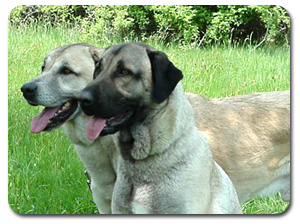
Photo: ©Kirako Anatolians
CLICK HERE to View Breeder Listings
Breed Profile
The Anatolian Shepherd is one of several large Turkish guarding breeds. He is considered a giant breed and was developed or naturally evolved to bond with flock animals. He is large, rugged and impressive and possesses great endurance and agility. The Anatolian is first and foremost a guarding dog. He is loyal and can be fiercely possessive and protective of his family, stock and territory. He is calm and observant of his surroundings and bold, without aggression when properly trained. The breed is naturally independent, very intelligent and obedient. He is suspicious of strangers and anything new that enters his domain, but loyal and affectionate to his owners.
Like all large, powerful breed, early socialization and training for Anatolian Shepherd Dogs is absolutely essential. The Anatolian must be taught not to interpret any “normal” activity or events as a threat. The well trained Anatolian should be self-confident yet submissive.
The Anatolian only reaches full maturity at the age of four years and the average lifespan is 12 to 15 years.
The Anatolian’s coat length can vary from short and smooth to long and rough, and comes in fawn, brindle, tri-colour, white and black. He carries his tail over his back when alert but otherwise it is carried low with a slight curl.
Health Issues
The Anatolian Shepherd is known as a breed with few serious health problems. The incidence of inherited problems seems to be much lower than in many other breeds. However, they are not completely free of health concerns and some of the issues which have been seen in the breed include:
- Hip Dysplasia
- Hypothyroidism
- Some forms of Cancer
- Gastric Torsion (Bloat) — As with any deep-chested dog, the occurrence of Bloat or Gastric Torsion is a real possibility in the Anatolian Shepherd. If you are not familiar with this condition, it is absolutely necessary to learn about it and know the symptoms — This is a real emergency and a life threatening condition that requires immediate Veterinary attention. See First Aid for Bloat for an article describing some of the things you can do if you are faced with this situation.
If you are considering the adoption of a Anatolian Shepherd puppy, or any breed, it is very important to be selective in choosing a responsible and reputable breeder. Ensure that the prospective puppy’s parents have all health clearances. Breeding of any dog should not be done until after they have been proven to be free of evidence of significant hereditary diseases. (For more information on selecting a breeder, see the articles on the General Information page.)
Additional Health Resources:
- Health and Nutrition — Growing section of the Canada’s Guide to Dogs website which includes information on several health and nutrition related issues.
- Canine Health Information Center (CHIC) — Providing a source of health information for owners, breeders, and scientists that will assist in breeding healthy dogs. CHIC is a centralized canine health database jointly sponsored by the AKC/Canine Health Foundation (AKC/CHF) and the Orthopedic Foundation for Animals (OFA).
- AKC Canine Health Foundation — Working towards developing scientific advances in canine health.
- OFA – Companion Animal Eye Registry (CAER)
- Orthopedic Foundation for Animals (OFA)
- Ontario Veterinary College (OVC)
- University of Pennsylvania Hip Improvement Program (PennHip)
- HealthGene — HealthGene Corporation is the leading provider of veterinary DNA diagnostic services in Canada.
- Labgenvet — Laboratory of Veterinary Genetics is a Canadian diagnostic laboratory that offers a comprehensive service of DNA tests for veterinary genetic diseases.
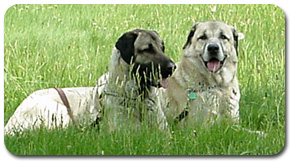
Photo courtesy of Kirako Anatolians
Grooming Information
- Grooming — This section of the Canada’s Guide to Dogs website includes tips, articles and information covering all aspects of dog grooming along with a listing of Groomers from across Canada.
Training Resources
- Starting the LGD Pup by Catherine de la Cruz
- Training — For training information, see this section of the Canada’s Guide to Dogs website for tips, articles, as well as listings of training centres across Canada.
Additional Information
- Working Livestock Guardian Dogs (LGD) — What is their Job?
- Livestock Guardian Dogs Factsheet
- Clubs, Sports & Activities — For information on the many sports and activities you can get involved in with your dog.
- Working Dogs — The Working Dogs section of the Canada’s Guide to Dogs website provides information and listings of organizations that are involved in various dog jobs, such as Guide Dogs, Therapy Dogs, Police Dogs, Protection Dogs, and much more.
*NOTE: The Fédération Cynologique International (FCI) is the World Canine Organization, which includes 91 members and contract partners (one member per country) that each issue their own pedigrees and train their own judges. The FCI recognizes 344 breeds, with each being the “property” of a specific country. The “owner” countries write the standards of these breeds in co-operation with the Standards and Scientific Commissions of the FCI, and the translation and updating are carried out by the FCI. The FCI is not a breed registry nor does it issue pedigrees.
Breed Listing

Quick Links
Get In Touch
- Email: canadasguidetodogs@gmail.com
- Visit us on Facebook: www.facebook.com/CanadasGuideToDogs
— CanadasGuideToDogs.com is an Amazon Associate as well as a participant in various affiliate programs, as such fees are earned from qualifying purchases.