

Appenzeller Sennenhund
Group: Guardian Dog Group
Origin: Switzerland
Height: Males: 52 – 56 cm – Females: 50 – 54 cm
Weight: 48 to 55 lbs
Other Names: Appenzeller Mountain Dog; Appenzell Cattle Dog
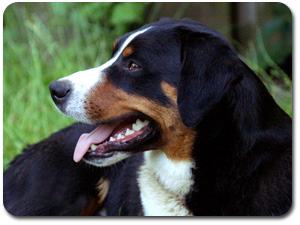
Photo courtesy: www.appenzellersennenhond.nl
Breed Profile
The Appenzeller Sennenhund is the rarest of the four Swiss dog breeds — the other three being: the Greater Swiss Mountain Dog, the Bernese Mountain Dog and the Entlebucher. The Appenzeller was originally bred as a cattle herding dog as well as livestock guardian in Switzerland. It is believed that the Greater Swiss Mountain Dog is the oldest of the Swiss breeds with the others descending from it. The first valid Breed Standard was prepared in 1914 with its original breeding territory being the Appenzell region. Today, the breed is found all over Switzerland and in many European countries. However, breeding stock is still limited and, though gaining in popularity, the breed is still considered rare in North America.
Today, Appenzellers are still commonly used as livestock guardians, herding dogs, draft animals and an all-purpose farm dogs. They can also be seen participating in obedience and performing Shutzhund work. In addition, Appenzellers work as Avalanche Rescue Dogs, Tracking Dogs and for protection work in Switzerland.
The Appenzeller is a muscular but not massive, medium-sized dog with a short, smooth coat. Unique to the Appenzeller, from the other three Swiss breeds, is the carrying of the tail curled over his back. In addition, he also has a more refined head and body. The most commonly seen Appenzeller coat colour is tri-coloured, with a black ground coat and rich rust and clear white markings. A base colour of “Havannah brown” — similar to the brown of a Chocolate Labrador Retriever — is sometimes seen.
Known for his agility, endurance and high energy, the Appenzeller is outgoing but suspicious of strangers. This is a working dog and bred as such. He has very strong protective instincts and is very loyal and devoted to his family, home and property. This is a dog who thrives in the company of his family, is very intelligent, easily trained and aims to please. The Appenzeller has a natural mistrust toward strangers and strong guarding instincts stemming from his work as a cattle dog. As a herding dog, he is known to instinctively sense the behaviour of each animal in the herd and often reacts before a situation occurs.
Because the Appenzeller is a high energy breed, he needs plenty of exercise both physical and mental and, therefore, is not the breed for everyone.
Health Issues
If you are considering the adoption of a Appenzeller Mountain Dog puppy, or any breed, it is very important to be selective in choosing a responsible and reputable breeder. Ensure that the prospective puppy’s parents have all health clearances. Breeding of any dog should not be done until after they have been proven to be free of evidence of significant hereditary diseases. (For more information on selecting a breeder, see the articles on the General Information page.)
Additional Health Resources:
- Health and Nutrition — This section of the Canada’s Guide to Dogs website includes information on several health and nutrition related issues.
- Canine Health Information Center (CHIC) — Providing a source of health information for owners, breeders, and scientists that will assist in breeding healthy dogs. CHIC is a centralized canine health database jointly sponsored by the AKC/Canine Health Foundation (AKC/CHF) and the Orthopedic Foundation for Animals (OFA).
- AKC Canine Health Foundation — Working towards developing scientific advances in canine health.
- OFA – Companion Animal Eye Registry (CAER)
- Orthopedic Foundation for Animals (OFA)
- Ontario Veterinary College (OVC)
- University of Pennsylvania Hip Improvement Program (PennHip)
- HealthGene — HealthGene Corporation is the leading provider of veterinary DNA diagnostic services in Canada.
- Labgenvet — Laboratory of Veterinary Genetics is a Canadian diagnostic laboratory that offers a comprehensive service of DNA tests for veterinary genetic diseases.
Breed Standards
Grooming Information
- Grooming — This section of the Canada’s Guide to Dogs website includes tips, articles and information covering all aspects of dog grooming along with a listing of Groomers from across Canada.

Photo: www.appenzellersennenhond.nl
Training Resources
- Starting the LGD Pup by Catherine de la Cruz
- Training — For training information, see this growing section of the Canada’s Guide to Dogs website for tips, articles, as well as listings of training centres across Canada.
Additional Information
- Herding Dogs — A section of the Canada’s Guide to Dogs website which includes training and general information about Herding/Stock Dogs; listing of Stock Dog Clubs and Associations; listing of upcoming shows and events; and more.
- Working Livestock Guardian Dogs (LGD) — What is their Job?
- Clubs, Sports & Activities — For information on the many sports and activities you can get involved in with your dog.
- Working Dogs — The Working Dogs section of the Canada’s Guide to Dogs website provides information and listings of organizations that are involved in various dog jobs, such as Guide Dogs, Therapy Dogs, Police Dogs, Protection Dogs, and much more.
*NOTE: The Fédération Cynologique International (FCI) is the World Canine Organization, which includes 91 members and contract partners (one member per country) that each issue their own pedigrees and train their own judges. The FCI recognizes 344 breeds, with each being the “property” of a specific country. The “owner” countries write the standards of these breeds in co-operation with the Standards and Scientific Commissions of the FCI, and the translation and updating are carried out by the FCI. The FCI is not a breed registry nor does it issue pedigrees.
Breed Listing

Quick Links
Get In Touch
- Email: canadasguidetodogs@gmail.com
- Email: info@canadasguidetodogs.com
- Visit us on Facebook: www.facebook.com/CanadasGuideToDogs
— CanadasGuideToDogs.com is an Amazon Associate as well as a participant in various affiliate programs, as such fees are earned from qualifying purchases.