

Argentine Dogo
Origin: Argentina
Height: 24-27 in. (62-68 cm)
Weight: 80-100 lb. (36-45 kg)
Other Names: Dogo Argentino; Argentinean Mastiff
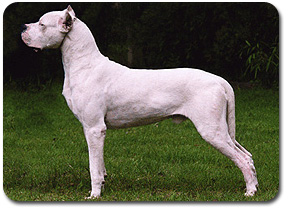
Rocco de Antares
Photo: Lirio Blanco Dogos Argentinos
CLICK HERE to View Breeder Listings
Breed Profile
The Argentine Dogo was first developed in the mid-1920s in Argentina and is the only internationally recognized dog breed from Argentina. The breed was bred as a fearless hunter capable of hunting big game, such as boar and mountain lion.
Developed by the brothers Martinez, Antonio and Agustin, they used the following formula to create the impressive White Mastiff:
They started with the now extinct Fighting Dog of Cordoba to which they added blood from the Pointer for his keen sense of smell; the Boxer for his spirit and gentleness; the Great Dane for his size; the Bull Terrier for his courage; the Bulldog for his boldness; the Irish Wolfhound for his instinct as a hunter; the Dogue de Bordeaux for his powerful jaws; the Great Pyrenees for his white coat; and the Spanish Mastiff for his power.
Physically, the Dogo gives an overall impression of great power. He is heavy-boned and very muscular, with a massive head, strong neck and deep, broad body. The short, thick coat is always white so as not to absorb heat. The Dogo is alert, determined, fearless, intelligent and versatile.
Today, the Dogo is often used for cattle protection and police work. He is a friendly, outgoing dog with an excellent temperament. He is generally good with children, gentle with other animals, and easily trained. The Dogo is a natural guardian and will defend a threatened family member and his home with his life. Because the Dogo distinguishes between familiar people and strangers, care must be taken to introduce friends and visitors. As with all large, powerful breeds, early socialization and training are a must for this breed.
Health Issues
The Dogo Argentino is generally a healthy breed; however, like all breeds, certain genetic disorders may be of concern.
- Deafness — Like many primarily white breeds, the Dogo may be born partially or completely deaf. Therefore, it is of great importance that ALL Dogos be BAER tested.
- Hip Dysplasia
If you are considering the adoption of a Argentine Dogo puppy, or any breed, it is very important to be selective in choosing a responsible and reputable breeder. Ensure that the prospective puppy’s parents have all health clearances. Breeding of any dog should not be done until after they have been proven to be free of evidence of significant hereditary diseases. (For more information on selecting a breeder, see the articles on the General Information page.)
Additional Health Resources:
- Health and Nutrition — This section of the Canada’s Guide to Dogs website includes information on several health and nutrition related issues.
- Canine Health Information Center (CHIC) — Providing a source of health information for owners, breeders, and scientists that will assist in breeding healthy dogs. CHIC is a centralized canine health database jointly sponsored by the AKC/Canine Health Foundation (AKC/CHF) and the Orthopedic Foundation for Animals (OFA).
- AKC Canine Health Foundation — Working towards developing scientific advances in canine health.
- OFA – Companion Animal Eye Registry (CAER)
- Orthopedic Foundation for Animals (OFA)
- Ontario Veterinary College (OVC)
- University of Pennsylvania Hip Improvement Program (PennHip)
- HealthGene — HealthGene Corporation is the leading provider of veterinary DNA diagnostic services in Canada.
- Labgenvet — Laboratory of Veterinary Genetics is a Canadian diagnostic laboratory that offers a comprehensive service of DNA tests for veterinary genetic diseases.
Breed Standards
In Canada, the breed is registered and recognized by the Canine Federation of Canada – www.caninecanada.ca/dogo-argentino. The breed is not currently recognized by the Canadian Kennel Club.
Grooming Information
- Grooming — This section of the Canada’s Guide to Dogs website includes tips, articles and information covering all aspects of dog grooming along with a listing of Groomers from across Canada.
Training Resources
- Training — For training information, see this growing section of the Canada’s Guide to Dogs website for tips, articles, as well as listings of training centres across Canada.
Additional Information
- Clubs, Sports & Activities — For information on the many sports and activities you can get involved in with your dog.
- Working Dogs — The Working Dogs section of the Canada’s Guide to Dogs website provides information and listings of organizations that are involved in various dog jobs, such as Guide Dogs, Therapy Dogs, Police Dogs, Protection Dogs, and much more.
*NOTE 1: CHIC – The Canine Health Information Center “is a database of consolidated health screening results from multiple sources. Co-sponsored by the Orthopedic Foundation for Animals (OFA) and the American Kennel Club (AKC) Canine Health Foundation, CHIC works with parent clubs to identify health screening protocols appropriate for individual breeds. Dogs tested in accordance with the parent club established requirements, that have their results registered and made available in the public domain are issued CHIC numbers.” To learn more, visit: www.caninehealthinfo.org
*NOTE 2: The Fédération Cynologique International (FCI) is the World Canine Organization, which includes 91 members and contract partners (one member per country) that each issue their own pedigrees and train their own judges. The FCI recognizes 344 breeds, with each being the “property” of a specific country. The “owner” countries write the standards of these breeds in co-operation with the Standards and Scientific Commissions of the FCI, and the translation and updating are carried out by the FCI. The FCI is not a breed registry nor does it issue pedigrees.
Breed Listing

Quick Links
Get In Touch
- Email: canadasguidetodogs@gmail.com
- Email: info@canadasguidetodogs.com
- Visit us on Facebook: www.facebook.com/CanadasGuideToDogs
— CanadasGuideToDogs.com is an Amazon Associate as well as a participant in various affiliate programs, as such fees are earned from qualifying purchases.