

Australian Shepherd
Group: Herding Group
Origin: United States
Height:
Males — 20-23 inches.
Females — 18-21 inches.
— As stated in all the major breed registry Standards: “Quality is not to be sacrificed in favor of size.” There are no disqualifying sizes and, as stated within the ASCA Standard Annotations: “…disqualifying sizes are unnecessary as agility and working efficiency rely more on sound structure than size.”
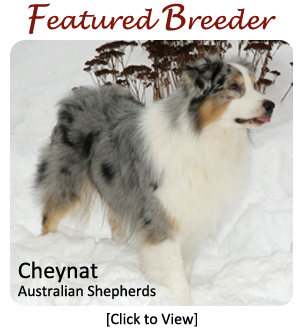
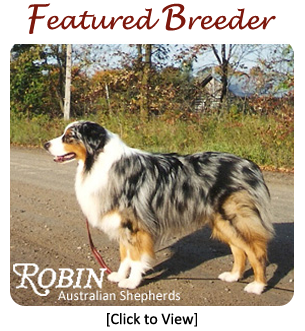
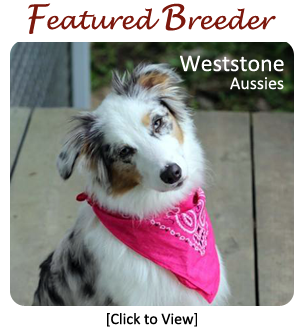
CLICK HERE to View Breeder Listings
Breed Profile
The Australian Shepherd is intelligent, very alert and eager, with strong herding and guarding instincts. He is good natured, never shy, fearful or aggressive toward people or animals, and is very loyal to his family. A wonderful companion, he is easy to train and always eager to please.
Aussies are high energy, very versatile dogs who enjoy having a job to do. The Australian Shepherd was bred to herd livestock and work as an all purpose farm/ranch dog. Today, however, while they still work as stockdogs, they are also seen working as Guide Dogs, Service Dogs, Therapy Dogs, Police and Narcotics Dogs, as well as Search and Rescue Dogs. In addition, they excel in all types of dog sports and activities, including Agility, Flyball and Obedience.
The Aussie is a people oriented dog who thrives on human companionship and is best suited to living indoors with his family. When properly socialized and trained, the Australian Shepherd is an ideal family dog who is gentle with small children, an enthusiastic playmate, and a protective guardian of home and family.
In physical appearance, the Australian Shepherd is a well-balanced, medium size dog, slightly longer than tall. Males appear masculine while females appear feminine without being slight of bone.
The Aussie’s coat colour is either blue merle, solid black, red (liver) merle, or solid red (liver) — all with or without white markings and/or copper points. The outer coat is straight to slightly wavy, of moderate length and weather resistant. The undercoat is soft and dense but varies with climate. The Australian Shepherd’s eyes are very expressive and may be brown, blue, amber, or any variation or combination of these and may also include flecks and marbling. A distinctive characteristic of the breed is his natural or docked bob tail.
Health Issues
The Australian Shepherd is generally a healthy breed with an average life expectancy of 12 or more years. However, like all breeds of dogs, the Australian Shepherd may be susceptible to certain health problems, including:
If you are considering the adoption of a Australian Shepherd puppy, or any breed, it is very important to be selective in choosing a responsible and reputable breeder. Ensure that the prospective puppy’s parents have all health clearances. Breeding of any dog should not be done until after they have been proven to be free of evidence of significant hereditary diseases. (For more information on selecting a breeder, see the articles on the General Information page.)
Recommended Health Screening:
The Australian Shepherd Club of America (ASCA) strongly recommends that breeding stock have clear eye checks and be OFA certified, and that breeders guarantee their pups to be free from Hip Dysplasia and other hereditary defects.
For the Australian Shepherd, the CHICNote 1 database includes health screenings for the following:
- Hip and Elbow Dysplasia; and
- Eye Examination by a board Ophthalmologist
- Optional recommendations include: Autoimmune Thyroiditis; Collie Eye Anomaly; and Multiple Drug Sensitivity.
Additional Health Resources:
- Australian Shepherd Health & Genetics Institute, Inc. (ASHGI)
- Canine Inherited Disorders Database — Australian Shepherd
- Health and Nutrition — This section of the Canada’s Guide to Dogs website includes information on several health and nutrition related issues.
- Canine Health Information Center (CHIC) — Australian Shepherd Recommended Health Screening — Providing a source of health information for owners, breeders, and scientists that will assist in breeding healthy dogs. CHIC is a centralized canine health database jointly sponsored by the AKC/Canine Health Foundation (AKC/CHF) and the Orthopedic Foundation for Animals (OFA).
- AKC Canine Health Foundation — Working towards developing scientific advances in canine health.
- OFA – Companion Animal Eye Registry (CAER)
- Orthopedic Foundation for Animals (OFA)
- Ontario Veterinary College (OVC)
- University of Pennsylvania Hip Improvement Program (PennHip)
- HealthGene — HealthGene Corporation is the leading provider of veterinary DNA diagnostic services in Canada.
- Labgenvet — Laboratory of Veterinary Genetics is a Canadian diagnostic laboratory that offers a comprehensive service of DNA tests for veterinary genetic diseases.
Breed Standards
- CKC Breed Standard
- AKC Breed Standard
- UKC Breed Standard
- The Kennel Club (U.K.) Breed Standard
- FCI Breed Standard No. 342
Grooming Information
The Australian Shepherd’s grooming needs are minimal with a weekly brushing recommended to help remove mats or tangles and dust. Toenail trimming and teeth cleaning are also suggested as part of the weekly grooming routine. During shedding season, a slicker brush helps remove undercoat.
- Grooming — This section of the Canada’s Guide to Dogs website includes tips, articles and information covering all aspects of dog grooming along with a listing of Groomers from across Canada.
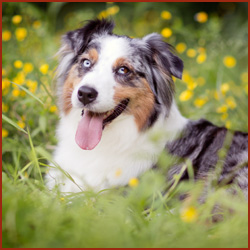
ASCA/CKC Ch. Meadowlawn’s Lost in the Moment ADC,SGDC, AADC, CGN
Photo by: Christina Conway | www.dazzlebydesign.ca
Training Resources
The Australian Shepherd is highly intelligent and learns very quickly. However, if left untrained, the typical Aussie is capable of out-witting his owner. Early obedience training is recommended for this breed.
As with all breeds, early socialization is also very important. While the Aussie is generally very friendly, they may be somewhat reserved with strangers and some can be over protective of their family and property.
Due to the Australian Shepherd’s strong herding instinct, fenced yards are a must for the breed. For many, the temptation to herd is very hard to resist, even for those who have never seen livestock. They may attempt to herd other animals, children or even cars.
The owner of an Australian Shepherd must be prepared to spend a considerable amount of play and training time with their dog. The Aussie was bred to work and, in general, is a high energy dog that needs a constructive outlet to spend that energy. For the active family, the Australian Shepherd is a wonderful companion who can participate in all kinds of activities and dog sports.
- Training — For training information, see this growing section of the Canada’s Guide to Dogs website for tips, articles, as well as listings of training centres across Canada.
Additional Information
- Is an Aussie Right for you? — From the ASCA
- Is a Dog from the Herding Group Right for you?
- Coat Color
- The White Aussie Project — This website exists to help explain white colouration in dogs, as clearly as possible. Although some of the terminology and the majority of the photos are Aussie specific, much of the information is applicable to other breeds.
- Herding Dogs — A section of the Canada’s Guide to Dogs website which includes training and general information about Herding/Stock Dogs; listing of Stock Dog Clubs and Associations; listing of upcoming shows and events; and more.
- Clubs, Sports & Activities — For information on the many sports and activities you can get involved in with your dog.
- Working Dogs — The Working Dogs section of the Canada’s Guide to Dogs website provides information and listings of organizations that are involved in various dog jobs, such as Guide Dogs, Therapy Dogs, Police Dogs, Protection Dogs, and much more.
*NOTE 1: CHIC – The Canine Health Information Center “is a database of consolidated health screening results from multiple sources. Co-sponsored by the Orthopedic Foundation for Animals (OFA) and the American Kennel Club (AKC) Canine Health Foundation, CHIC works with parent clubs to identify health screening protocols appropriate for individual breeds. Dogs tested in accordance with the parent club established requirements, that have their results registered and made available in the public domain are issued CHIC numbers.” To learn more, visit: www.caninehealthinfo.org
*NOTE 2: The Fédération Cynologique International (FCI) is the World Canine Organization, which includes 91 members and contract partners (one member per country) that each issue their own pedigrees and train their own judges. The FCI recognizes 344 breeds, with each being the “property” of a specific country. The “owner” countries write the standards of these breeds in co-operation with the Standards and Scientific Commissions of the FCI, and the translation and updating are carried out by the FCI. The FCI is not a breed registry nor does it issue pedigrees.
Breed Listing

Quick Links
Get In Touch
- Email: canadasguidetodogs@gmail.com
- Visit us on Facebook: www.facebook.com/CanadasGuideToDogs
— CanadasGuideToDogs.com is an Amazon Associate as well as a participant in various affiliate programs, as such fees are earned from qualifying purchases.