

Boston Terrier
Group: Non-Sporting Group
Origin: United States
Height: 15-17 inches (38.1-43 cm)
Weight:
- – Light: under 15 lbs/7 kg
– Middleweight: 15 to under 20 lbs/9 kg
– Heavyweight: 20 to under 25 lbs/11.5 kg
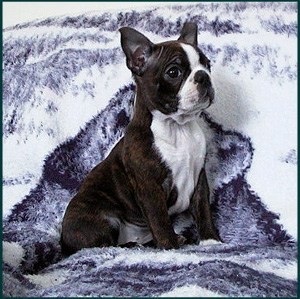
Razor’s Edge Morning Sunshine
Photo: Razor’s Edge
CLICK HERE to View Breeder Listings
Breed Profile
The Boston Terrier is one of the few dog breeds that is native to the United States and is a crossbreed between the Bulldog and the now extinct White English Terrier. From there, much inbreeding and crossbreeding was done with the Miniature Bulldog and French Bulldog. The breed was first recognized by the American Kennel Club in 1893 and by the Canadian Kennel Club in 1888-1889. Between 1929 and 1935, the Boston Terrier was the most popular breed in the United States.
He is a friendly and lively dog, noted for his excellent disposition and high intelligence. He is kind, gentle and affectionate, a natural watchdog and a very devoted companion for people of all ages, including children. He enjoys competing in obedience, agility, flyball and tracking events.
The Boston Terrrier is a true companion, all dressed up in his tuxedo, he has earned the nickname: “The American Gentleman”.
It should be noted that Bostons are indoor dogs. Their short, sleek coats do not protect them from the cold in winter and, in hot weather, their short muzzles make them susceptible to heat distress. Boston Terriers MUST be kept indoors.
Health Issues
If you are considering the adoption of a Boston Terrier puppy, or any breed, it is very important to be selective in choosing a responsible and reputable breeder. Ensure that the prospective puppy’s parents have all health clearances. Breeding of any dog should not be done until after they have been proven to be free of evidence of significant hereditary diseases. (For more information on selecting a breeder, see the articles on the General Information page.)
Some of the health concerns found in the Boston Terrier breed include:
- Brachycephalic Airway Obstruction Syndrome (BAOS) — Brachycephalics refers to breeds which have a comparatively short head. Because of this, virtually all of these breeds require some work associated with breathing. Problems range in severity, with most of these breeds snuffling and snorting to some degree. While some dogs will have no other difficulties, others will have problems such as increasingly noisy breathing, coughing and gagging, fainting or collapsing episodes, and a decreased tolerance for exercise. In addition, over time, increased strain is placed on the heart. Precautions must be taken in conditions where overheating, excitement and exercise causes increased panting. This increased panting can cause further swelling and narrowing of the airways. Gastrointestinal problems causing vomiting, gagging, or aspiration pneumonia may also be due to this syndrome. A recent BTCA Health Survey indicates that over 6% of Boston Terriers are born with either stenotic nares or elongated palates (or both).
- Hypothyroidism
- Eye Diseases — Corneal Ulcers and Prevention Corneal Ulcers are the biggest eye roblem in Boston Terriers.
- Patellar Luxation
- Deafness — Deafness has been known in the Boston Terrier since the origins of the breed.
- Demodectic Mange
Recommended Health Screening:
For the Boston Terrier, the CHICNote 1 database includes health screenings for:
- Eye Examination by a board Ophthalmologist
- Patellar Luxation
- Congenital Deafness
Additional Health Resources:
- Boston Terrier Health — from the Boston Terrier Club of America
- Canine Inherited Disorders Database — Boston Terrier
- Health and Nutrition — Growing section of the Canada’s Guide to Dogs website which includes information on several health and nutrition related issues.
- Canine Health Information Center (CHIC) — Providing a source of health information for owners, breeders, and scientists that will assist in breeding healthy dogs. CHIC is a centralized canine health database jointly sponsored by the AKC/Canine Health Foundation (AKC/CHF) and the Orthopedic Foundation for Animals (OFA).
- AKC Canine Health Foundation — Working towards developing scientific advances in canine health.
- OFA – Companion Animal Eye Registry (CAER)
- Orthopedic Foundation for Animals (OFA)
- Ontario Veterinary College (OVC)
- University of Pennsylvania Hip Improvement Program (PennHip)
- HealthGene — HealthGene Corporation is the leading provider of veterinary DNA diagnostic services in Canada.
- Labgenvet — Laboratory of Veterinary Genetics is a Canadian diagnostic laboratory that offers a comprehensive service of DNA tests for veterinary genetic diseases.

Grooming Information
- Grooming — This section of the Canada’s Guide to Dogs website includes tips, articles and information covering all aspects of dog grooming along with a listing of Groomers from across Canada.
Training Resources
- Training — For training information, see this growing section of the Canada’s Guide to Dogs website for tips, articles, as well as listings of training centres across Canada.
Additional Information
- The Boston Terrier — A True American Gentleman — Article written and submitted by: Blake Kritzberg
- Clubs, Sports & Activities — For information on the many sports and activities you can get involved in with your dog.
- Working Dogs — The Working Dogs section of the Canada’s Guide to Dogs website provides information and listings of organizations that are involved in various dog jobs, such as Guide Dogs, Therapy Dogs, Police Dogs, Protection Dogs, and much more.
*NOTE 1: CHIC – The Canine Health Information Center “is a database of consolidated health screening results from multiple sources. Co-sponsored by the Orthopedic Foundation for Animals (OFA) and the American Kennel Club (AKC) Canine Health Foundation, CHIC works with parent clubs to identify health screening protocols appropriate for individual breeds. Dogs tested in accordance with the parent club established requirements, that have their results registered and made available in the public domain are issued CHIC numbers.” To learn more, visit: www.caninehealthinfo.org
*NOTE 2: The Fédération Cynologique International (FCI) is the World Canine Organization, which includes 91 members and contract partners (one member per country) that each issue their own pedigrees and train their own judges. The FCI recognizes 344 breeds, with each being the “property” of a specific country. The “owner” countries write the standards of these breeds in co-operation with the Standards and Scientific Commissions of the FCI, and the translation and updating are carried out by the FCI. The FCI is not a breed registry nor does it issue pedigrees.
Breed Listing

Quick Links
Get In Touch
- Email: canadasguidetodogs@gmail.com
- Visit us on Facebook: www.facebook.com/CanadasGuideToDogs
— CanadasGuideToDogs.com is an Amazon Associate as well as a participant in various affiliate programs, as such fees are earned from qualifying purchases.