

Briard
Group: Herding Group
Origin: France
Height: 22 to 27 inches (56 to 69 cm) at the shoulder.
Weight: 70 to 90 lbs. (31½ to 40½ kg).
Also Known As: Chien Berger de Brie
CLICK HERE to View Breeder Listings
Breed Profile
The Briard, also known as the Chien Berger de Brie, is said to be “a heart of gold wrapped in fur.” He is intelligent, loyal, eager to please and naturally protective. In the home environment, he is calm and relaxed but while working, he can trot all day long without tiring.
The Briard is an ancient French herding breed dating back to the eighth century. The Emperor Charlemagne as well as Napoleon were said to have owned this breed of dog. Since early times, the Briard was used as a guardian of the flocks and a herding dog. He was the official dog of the French army and, because so many were lost in both world wars, the Briard is somewhat rare today. Used as sentry dogs, to carry supplies to the front lines, and to search for wounded soldiers, the Briard was reported to have an amazing ability to lead the medical corps to the wounded.
Along with his loyalty and courage, he is completely devoted to his home and family, especially children, and makes an excellent guardian and watch dog. As with most herding breeds, the Briard is an independent thinker. However, he is obedient, learns quickly and has an excellent memory.
The Briard is a versatile herding dog who fetches, drives and does boundary work. He can also work all types of livestock and works as the shepherd’s partner with a very keen herding instinct. Known as an upright breed, he works quietly, circling, and exhibiting a natural “power”, always eager, intense and alert. Being a working breed, he enjoys having a job to do — be it herding, guarding, agility, tracking, or even carting.
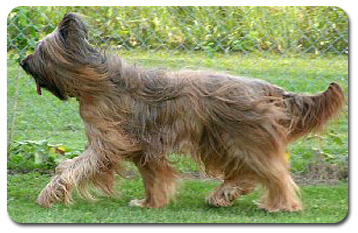
He has a long outer coat that is coarse, hard and dry. It lies flat on his body, falling in a slight wave. The undercoat is soft and fine. His strong head is covered with hair that arches into eyebrows and forms a beard under his chin. The most common coat colours are tawny or black with the occasional blue-grey being seen.
Health Issues
If you are considering the adoption of a Briard puppy, or any breed, it is very important to be selective in choosing a responsible and reputable breeder. Ensure that the prospective puppy’s parents have all health clearances. Breeding of any dog should not be done until after they have been proven to be free of evidence of significant hereditary diseases. (For more information on selecting a breeder, see the articles on the General Information page.)
Bloat — As with many large breeds, the occurrence of Bloat or Gastric Torsion is a real possibility in the Briard. If you are not familiar with this condition, it is absolutely necessary to learn about it and know the symptoms — This is a real emergency and a life threatening condition that requires immediate Veterinary attention. See Gastric Dilatation Volvulus (GDV) — Bloat in the Health and Nutrition section of the Canada’s Guide to Dogs website for more information and Bloat Information from the Briard Medical Trust, as well as First Aid for Bloat for an article describing some of the things you can do if you are faced with this situation.
Recommended Health Screening:
The Briard Club of America recommends testing for genetic disorders including Hip Dysplasia, Progressive Retinal Atrophy, von Willebrand’s Disease, Hypothyroidism, night blindness, and other tests as they become available should be done before breeding.
For the Briard the CHICNote 1 database includes health screenings for:
- Hip Dysplasia (minimum age: 24 months for all tests)
- Eye Examination by a board Ophthalmologist at least once between six months and 8 years of age.
- Stationary Night Blindness
- Also listed as optional: Autoimmune Thyroiditis and Elbow Dysplasia
Additional Health Resources:
- Canine Health Information Center (CHIC) — Providing a source of health information for owners, breeders, and scientists that will assist in breeding healthy dogs. CHIC is a centralized canine health database jointly sponsored by the AKC/Canine Health Foundation (AKC/CHF) and the Orthopedic Foundation for Animals (OFA).
- Health and Nutrition — Growing section of the Canada’s Guide to Dogs website which includes information on several health and nutrition related issues.
- AKC Canine Health Foundation — Working towards developing scientific advances in canine health.
- OFA – Companion Animal Eye Registry (CAER)
- Orthopedic Foundation for Animals (OFA)
- Ontario Veterinary College (OVC)
- University of Pennsylvania Hip Improvement Program (PennHip)
- HealthGene — HealthGene Corporation is the leading provider of veterinary DNA diagnostic services in Canada.
- Labgenvet — Laboratory of Veterinary Genetics is a Canadian diagnostic laboratory that offers a comprehensive service of DNA tests for veterinary genetic diseases.
Grooming Information
- Grooming — This section of the Canada’s Guide to Dogs website includes tips, articles and information covering all aspects of dog grooming along with a listing of Groomers from across Canada.
Training Resources
Because guarding and herding are natural instincts to the Briard, he can be somewhat aloof toward strangers. Therefore, early socialization is strongly recommended and this will not deter his guarding instincts.
- Training — For training information, see this growing section of the Canada’s Guide to Dogs website for tips, articles, as well as listings of training centres across Canada.
Additional Information
- Is a Dog from the Herding Group Right for You?
- Herding Dogs — The Herding Dogs section of the Canada’s Guide to Dogs website includes training and general information about Herding/Stock Dogs; listing of Stock Dog Clubs and Associations; listing of upcoming shows and events; and more.
- Clubs, Sports & Activities — For information on the many sports and activities you can get involved in with your dog.
- Working Dogs — The Working Dogs section of the Canada’s Guide to Dogs website provides information and listings of organizations that are involved in various dog jobs, such as Guide Dogs, Therapy Dogs, Police Dogs, Protection Dogs, and much more.
*NOTE 1: CHIC – The Canine Health Information Center “is a database of consolidated health screening results from multiple sources. Co-sponsored by the Orthopedic Foundation for Animals (OFA) and the American Kennel Club (AKC) Canine Health Foundation, CHIC works with parent clubs to identify health screening protocols appropriate for individual breeds. Dogs tested in accordance with the parent club established requirements, that have their results registered and made available in the public domain are issued CHIC numbers.” To learn more, visit: www.caninehealthinfo.org
*NOTE 2: The Fédération Cynologique International (FCI) is the World Canine Organization, which includes 91 members and contract partners (one member per country) that each issue their own pedigrees and train their own judges. The FCI recognizes 344 breeds, with each being the “property” of a specific country. The “owner” countries write the standards of these breeds in co-operation with the Standards and Scientific Commissions of the FCI, and the translation and updating are carried out by the FCI. The FCI is not a breed registry nor does it issue pedigrees.
Breed Listing

Quick Links
Get In Touch
- Email: canadasguidetodogs@gmail.com
- Email: info@canadasguidetodogs.com
- Visit us on Facebook: www.facebook.com/CanadasGuideToDogs
— CanadasGuideToDogs.com is an Amazon Associate as well as a participant in various affiliate programs, as such fees are earned from qualifying purchases.