

Australian Cattle Dog
Group: Herding Group
Origin: Australia
Height: Males 46-51 cm (18-20 in) at the withers.
Weight: Males 33 to 50 lbs.
Also Referred to as: Heeler; Blue Heeler; Red Heeler; Queensland Heeler; Queensland Blue Heeler; and Queensland Red Heeler
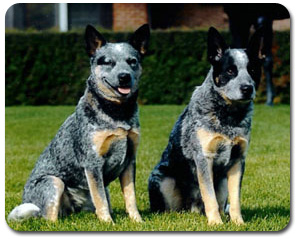
“Phoenix” Ch. Dalaussie’s Spider’s Phoenix and “Eli” S.R. OTCH. Ch. Dalaussie’s Elijah Creek AgI. AADC. DAC. OGC. OJC.
Photo: Dalaussie Australian Cattle Dogs
CLICK HERE to View Breeder Listings
Breed Profile
The Australian Cattle Dog was developed in Australia in the mid to late 1800’s to be a silent worker able to control livestock in wide-open spaces as well as in the stockyard. It is believed that the breed was developed using the Native Australian Dog (Dingo), the Dalmatian, the Bull Terrier, and the Australian Kelpie, among others.
For further information about breed history, see ACD Breed History from the Australian Cattle Dog Club of America, Inc. website.
He is a sturdy, agile dog with strength and endurance. He is highly intelligent, loyal, alert, watchful, courageous and protective. The breed makes an excellent watch dog and is extremely loyal to his family. ACDs are known for their devotion to family — often referred to as “velcro dogs”, some will bond more closely to one person while others bond to the whole family. Either way, the Australian Cattle Dog absolutely needs to be around the people he bonds to.
He is a superb worker with remarkable reasoning power. The ACD is a high energy, extremely active dog who absolutely requires mental and physical stimulation. Besides the natural herding abilities of the Cattle Dog, the breed excels at such sports as Flyball, Agility and Frisbee competition. He is also seen in the Conformation ring as well as in Competitive Obedience.
His double coat may be either red or blue speckle, with or without particular markings.
Health Issues
A relatively healthy and long-lived breed, the Australian Cattle Dog’s average life expectancy is 12 to 15 years with many living well beyond that age. (The longest-lived dog as recorded by the Guinness Book of World Records is an Australian Cattle Dog — He reportedly lived to 29 years of age.)
If you are considering the adoption of a Australian Cattle Dog puppy, or any breed, it is very important to be selective in choosing a responsible and reputable breeder. Ensure that the prospective puppy’s parents have all health clearances. Breeding of any dog should not be done until after they have been proven to be free of evidence of significant hereditary diseases. (For more information on selecting a breeder, see the articles on the General Information page.)
Recommended Health Screening:
The Australian Cattle Dog Club of America recommends that breeders have their breeding stock:
- X-rayed for hips and elbows;
- CERF testing for inherited eye diseases;
- BAER testing for deafness; and
- DNA testing for the detection of PRA.
For the Australian Cattle Dog, the CHICNote 1 database includes health screenings for the following:
- Hip and Elbow Dysplasia (Evaluation at two years or older);
- Eye Examination by a board Ophthalmologist;
- Progressive Retinal Atrophy (PRA) DNA Test – from approved laboratory; and
- Congenital Deafness
- Optional recommendations include Patellar Luxation; Congenital Cardiac Database; PennHip; and Radiographic Consultation for OCD of the Hocks.
Additional Health Resources:
- Australian Cattle Dog Health Concerns
- Canine Inherited Disorders Database — Australian Cattle Dog
- Health and Nutrition — This section of the Canada’s Guide to Dogs website includes information on several health and nutrition related issues.
- Canine Health Information Center (CHIC) — Providing a source of health information for owners, breeders, and scientists that will assist in breeding healthy dogs. CHIC is a centralized canine health database jointly sponsored by the AKC/Canine Health Foundation (AKC/CHF) and the Orthopedic Foundation for Animals (OFA).
- AKC Canine Health Foundation — Working towards developing scientific advances in canine health.
- OFA – Companion Animal Eye Registry (CAER)
- Orthopedic Foundation for Animals (OFA)
- Ontario Veterinary College (OVC)
- University of Pennsylvania Hip Improvement Program (PennHip)
- HealthGene — HealthGene Corporation is the leading provider of veterinary DNA diagnostic services in Canada.
- Labgenvet — Laboratory of Veterinary Genetics is a Canadian diagnostic laboratory that offers a comprehensive service of DNA tests for veterinary genetic diseases.
Breed Standards
- CKC Breed Standard
- AKC Breed Standard
- Working Standard for the Australian Cattle Dog (As shown on the ACD Club of America website)
- UKC Breed Standard
- FCI Standard No 287
- The Kennel Club (U.K.) Breed Standard

Grooming Information
The Australian Cattle Dog requires minimal grooming — Regular brushing and proper nutrition will help maintain a healthy coat. Toe nails should be kept trimmed and ears clean. The pads under the feet should also be checked regularly for cuts or bruises.
- Grooming — This section of the Canada’s Guide to Dogs website includes tips, articles and information covering all aspects of dog grooming along with a listing of Groomers from across Canada.
Training Resources
- Training — For training information, see this section of the Canada’s Guide to Dogs website for tips, articles, as well as listings of training centres across Canada.
Additional Information
- Is a Dog from the Herding Group Right for you?
- Herding Dogs — A section of the Canada’s Guide to Dogs website which includes training and general information about Herding/Stock Dogs; listing of Stock Dog Clubs and Associations; listing of upcoming shows and events; and more.
- Clubs, Sports & Activities — For information on the many sports and activities you can get involved in with your dog.
- Working Dogs — The Working Dogs section of the Canada’s Guide to Dogs website provides information and listings of organizations that are involved in various dog jobs, such as Guide Dogs, Therapy Dogs, Police Dogs, Protection Dogs, and much more.
*NOTE 1: CHIC – The Canine Health Information Center “is a database of consolidated health screening results from multiple sources. Co-sponsored by the Orthopedic Foundation for Animals (OFA) and the American Kennel Club (AKC) Canine Health Foundation, CHIC works with parent clubs to identify health screening protocols appropriate for individual breeds. Dogs tested in accordance with the parent club established requirements, that have their results registered and made available in the public domain are issued CHIC numbers.” To learn more, visit: www.caninehealthinfo.org
*NOTE 2: The Fédération Cynologique International (FCI) is the World Canine Organization, which includes 91 members and contract partners (one member per country) that each issue their own pedigrees and train their own judges. The FCI recognizes 344 breeds, with each being the “property” of a specific country. The “owner” countries write the standards of these breeds in co-operation with the Standards and Scientific Commissions of the FCI, and the translation and updating are carried out by the FCI. The FCI is not a breed registry nor does it issue pedigrees.
Breed Listing

Quick Links
Get In Touch
- Email: canadasguidetodogs@gmail.com
- Visit us on Facebook: www.facebook.com/CanadasGuideToDogs
— CanadasGuideToDogs.com is an Amazon Associate as well as a participant in various affiliate programs, as such fees are earned from qualifying purchases.