

Chow Chow
Group: Non-Sporting Group
Origin: China
Height: 17 to 20 inches at the shoulder.
Weight: 40 to 70 lbs.

CLICK HERE to View Breeder Listings
Breed Profile
The Chow Chow, originally from Northern China, is one of the oldest recognizable dog breeds, dating back more than 2000 years. He was once used for hunting, herding, pulling and protection. Today, he is primarily a companion dog.
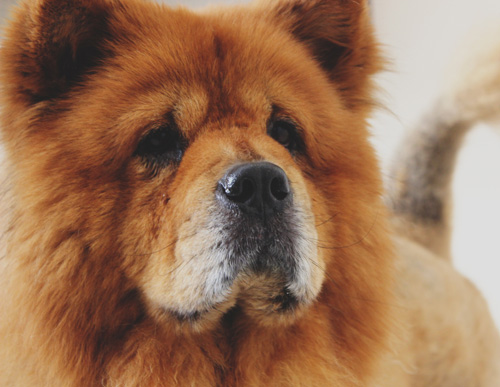
With his lion-like appearance and regal manner, the Chow is truly one of the most beautiful and impressive breeds of dogs. He is very intelligent but has cat-like characteristics in that he does not always have the desire to please like many other breeds, preferring instead to do what suits his particular mood. He is dignified, independent, and reserved with affection.
The properly trained Chow makes a wonderful companion. He is very quiet, well-behaved, not a barker and not destructive. He is excellent with children if raised with them and very protective of his home and family. This natural protective instinct along with his reservation toward strangers make him an excellent watch dog who only barks when necessary.
The Chow Chow’s coat is either rough or smooth. The most common coat is the rough (long-haired) which has a outer coat of long, straight, course guard hairs and a soft, thick undercoat. The smooth variety is a short, dense outer coat with a definite undercoat. These are two distinct varieties of Chow. There are, however, many rough coated Chows with fairly short coats but these should not be confused with the true unique, smooth coat.
One unique characteristic that is found in the breed is a blue-black tongue. The coat comes in five colours: red, black, cinnamon, blue and cream. The most common is red which varies from a light golden to a deep mahogany.
Health Issues
The Chow is a long-lived breed with most living to about 14 or 15 years. As with all breeds, however, Chows can be prone to some health problems. The following are the most common found in the breed:
- Hip Dysplasia
- Entropion — A condition where the dog’s eyelids turn inward toward the eyeball rather than outward as they should. This causes irritation to the eye and, if left untreated, can lead to blindness. It is usually inherited but can also be acquired later in life as a result of eye injury or infection. It is not always apparent in young puppies so be sure to inspect the puppy’s and parents eyes. The sire and dam’s eyes should appear clear, dry, and sparkling. Runny, inflamed eyes or crusty eyelids are not normal for a Chow and should be treated by a veterinarian.
- Skin and hormone problems
If you are considering the adoption of a Chow Chow puppy, or any breed, it is very important to be selective in choosing a responsible and reputable breeder. Ensure that the prospective puppy’s parents have all health clearances. This should include, among others, hip x-rays to exclude hip dysplasia and eyes should be checked to see that they are normal. Breeding of any dog should not be done until after they have been proven to be free of evidence of significant hereditary diseases. (For more information on selecting a breeder, see the articles on the General Information page.)
Recommended Health Screening:
For the Chow Chow, the CHICNote 1 database includes health screenings for:
- Eye Examination by a board Ophthalmologist
- Elbow Dysplasia
- Hip Dysplasia
- Autoimmune Thyroiditis
- Patellar Luxation
Additional Health Resources:
- Entropion – A Common Eye Problem in Chow Chows
- Canine Inherited Disorders Database — Chow Chow
- Health and Nutrition — Growing section of the Canada’s Guide to Dogs website which includes information on several health and nutrition related issues.
- Canine Health Information Center (CHIC) — Providing a source of health information for owners, breeders, and scientists that will assist in breeding healthy dogs. CHIC is a centralized canine health database jointly sponsored by the AKC/Canine Health Foundation (AKC/CHF) and the Orthopedic Foundation for Animals (OFA).
- AKC Canine Health Foundation — Working towards developing scientific advances in canine health.
- OFA – Companion Animal Eye Registry (CAER)
- Orthopedic Foundation for Animals (OFA)
- Ontario Veterinary College (OVC)
- University of Pennsylvania Hip Improvement Program (PennHip)
- HealthGene — HealthGene Corporation is the leading provider of veterinary DNA diagnostic services in Canada.
- Labgenvet — Laboratory of Veterinary Genetics is a Canadian diagnostic laboratory that offers a comprehensive service of DNA tests for veterinary genetic diseases.
Grooming Information
The adult Chow’s thick coat requires a minimum of weekly grooming. The puppy coat is very dense and soft, easily tangled and can take several hours a week to groom. The transition period from puppy to adult coat may take several months and the Chow needs to be groomed almost daily during this time.
- Grooming Your Pet Chow Chow
- Grooming — This section of the Canada’s Guide to Dogs website includes tips, articles and information covering all aspects of dog grooming along with a listing of Groomers from across Canada.
Training Resources
Early socialization and training is a must for the Chow Chow as he can be stubborn and very strong willed. While he may seem very well behaved as a young puppy, the adolescent Chow, if not trained when young, may refuse to accept authority. Puppy kindergarten classes are highly recommended for early socialization and obedience classes as soon as the puppy is old enough.
- Chow Chow Socialization
- Training — For training information, see this growing section of the Canada’s Guide to Dogs website for tips, articles, as well as listings of training centres across Canada.
Additional Information
- Clubs, Sports & Activities — For information on the many sports and activities you can get involved in with your dog.
- Working Dogs — The Working Dogs section of the Canada’s Guide to Dogs website provides information and listings of organizations that are involved in various dog jobs, such as Guide Dogs, Therapy Dogs, Police Dogs, Protection Dogs, and much more.
*NOTE 1: CHIC – The Canine Health Information Center “is a database of consolidated health screening results from multiple sources. Co-sponsored by the Orthopedic Foundation for Animals (OFA) and the American Kennel Club (AKC) Canine Health Foundation, CHIC works with parent clubs to identify health screening protocols appropriate for individual breeds. Dogs tested in accordance with the parent club established requirements, that have their results registered and made available in the public domain are issued CHIC numbers.” To learn more, visit: www.caninehealthinfo.org
*NOTE 2: The Fédération Cynologique International (FCI) is the World Canine Organization, which includes 91 members and contract partners (one member per country) that each issue their own pedigrees and train their own judges. The FCI recognizes 344 breeds, with each being the “property” of a specific country. The “owner” countries write the standards of these breeds in co-operation with the Standards and Scientific Commissions of the FCI, and the translation and updating are carried out by the FCI. The FCI is not a breed registry nor does it issue pedigrees.
Breed Listing

Quick Links
Get In Touch
- Email: canadasguidetodogs@gmail.com
- Visit us on Facebook: www.facebook.com/CanadasGuideToDogs
— CanadasGuideToDogs.com is an Amazon Associate as well as a participant in various affiliate programs, as such fees are earned from qualifying purchases.