

Dogue de Bordeaux
Group: Working Group
Origin: France
Height:
- – Males: 23½ to 26½ inches
– Females: 22½ to 25½ inches
Weight:
- – Males: Ideal min. 110 lbs
– Females: Ideal min. 99 lbs
Other Names: French Mastiff
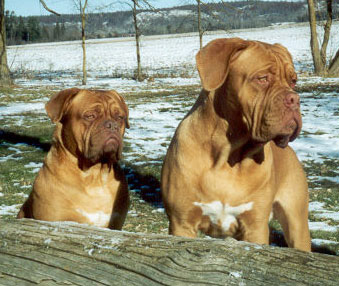
Photo: Nobelgaze’s Dogue de Bordeaux Kennel
CLICK HERE to View Breeder Listings
Breed Profile
He is a well-balanced, massive, powerfully-built dog with a very muscular body and a short coat. He has an attractive colouring of either mahogany (red-brown), fawn or golden. He may or may not also have either a red or black mask.
The Dogue de Bordeaux was originally used as a guardian, hunter, and as a fighter of bears, bulls and wolves. The breed’s history is filled with various theories but what is known is by the late 1800s, there was much diversity in the breed with three different styles — the Toulouse, the Paris and the Bordeaux. Today’s Dogue is a mixture of the different types but primarily Bordeaux. During the 1960s, Dr. Raymond Triquet was responsible for heading up the rebuilding of the breed and, in 1970, he wrote the new standard for the breed as he is known today.
In 1986, after the release of the movie “Turner and Hooch” starring Tom Hanks as Turner and a Dogue as Hooch, a small increase in popularity occured in the United States. Today, the breed is still considered rare in North America but with selective and careful breeding, some of the finest Dogues in the world are now found on this continent.
The Dogue is even tempered, protective by nature, and extremely devoted to his family. With the Dogue’s original purpose being to fight and protect, he can be aggressive by nature; however, throughout the years, breeders have been trying to breed this characteristic out. The Dogue is intelligent and can also be stubborn, arrogant, and dominant. Early socialization for this breed is an absolute must.
Today, the Dogue is most commonly used as a guardian of the home. He assumes this responsibility with vigilance and courage but without aggressiveness. He enjoys human companionship with a fierce loyalty to his family, he is affectionate, devoted to his master and excellent with children.
Health Issues
Like all breeds of dogs, the Dogue de Bordeaux is susceptible to certain health problems. See the Health Concerns in the Dogue de Bordeaux document for details on some of the health concerns found in this breed. If you are considering the purchase of a Dogue de Bordeaux puppy, or any breed, it is very important to be selective in choosing a responsible and reputable breeder. Ensure that the prospective puppy’s parents have all health clearances. Breeding of any dog should not be done until after they have been proven to be free of evidence of significant hereditary diseases. (For more information on selecting a breeder, see the articles on the General Information page.)
Recommended Health Screening:
For the Dogue de Bordeaux, the CHICNOTE 1 database includes health screenings for:
- Congenital Cardiac Database
- Elbow Dysplasia
- Hip Dysplasia
- Shoulders
- Also listed as “optional”: Eye Examination by a board Ophthalmologist; Autoimmune Thyroiditis; Patellar Luxation
Additional Health Resources:
- Health Concerns in the Dogue de Bordeaux
- Health and Nutrition — Growing section of the Canada’s Guide to Dogs website which includes information on several health and nutrition related issues.
- Canine Health Information Center (CHIC) — Providing a source of health information for owners, breeders, and scientists that will assist in breeding healthy dogs. CHIC is a centralized canine health database jointly sponsored by the AKC/Canine Health Foundation (AKC/CHF) and the Orthopedic Foundation for Animals (OFA).
- AKC Canine Health Foundation — Working towards developing scientific advances in canine health.
- OFA – Companion Animal Eye Registry (CAER)
- Orthopedic Foundation for Animals (OFA)
- Ontario Veterinary College (OVC)
- University of Pennsylvania Hip Improvement Program (PennHip)
- HealthGene — HealthGene Corporation is the leading provider of veterinary DNA diagnostic services in Canada.
- Labgenvet — Laboratory of Veterinary Genetics is a Canadian diagnostic laboratory that offers a comprehensive service of DNA tests for veterinary genetic diseases.
Breed Standards
In Canada, the Dogue de Bordeaux is currently a “Listed Breed” under the Canadian Kennel Club and can be registered with the Canine Federation of Canada.
Grooming Information
- Grooming — This section of the Canada’s Guide to Dogs website includes tips, articles and information covering all aspects of dog grooming along with a listing of Groomers from across Canada.
Training Resources
- Training — For training information, see this growing section of the Canada’s Guide to Dogs website for tips, articles, as well as listings of training centres across Canada.
Additional Information
- Clubs, Sports & Activities — For information on the many sports and activities you can get involved in with your dog.
- Working Dogs — The Working Dogs section of the Canada’s Guide to Dogs website provides information and listings of organizations that are involved in various dog jobs, such as Guide Dogs, Therapy Dogs, Police Dogs, Protection Dogs, and much more.
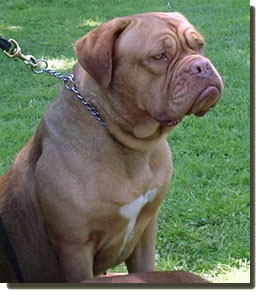
Baltic’s Finale of Chienparadis
Photo Baltic Bordeaux
Did You Know?
- The Dogue de Bordeaux, or French Mastiff as he is also known, originates from France and is one of the oldest French breeds with a history dating back several centuries.
- Historically, the breed was used as a guardian of homes, estates, and livestock. They have a natural protective instinct, making them effective guard dogs.
- Despite their imposing appearance, Dogues de Bordeaux are known for their gentle and affectionate nature. They are loyal, good-natured, and often develop strong bonds with their families.
- The breed gained international recognition and popularity after appearing in the movie “Turner & Hooch,” where a Dogue de Bordeaux played a prominent role alongside actor Tom Hanks.
*NOTE 1: CHIC – The Canine Health Information Center “is a database of consolidated health screening results from multiple sources. Co-sponsored by the Orthopedic Foundation for Animals (OFA) and the American Kennel Club (AKC) Canine Health Foundation, CHIC works with parent clubs to identify health screening protocols appropriate for individual breeds. Dogs tested in accordance with the parent club established requirements, that have their results registered and made available in the public domain are issued CHIC numbers.” To learn more, visit: www.caninehealthinfo.org
*NOTE 2: The Fédération Cynologique International (FCI) is the World Canine Organization, which includes 91 members and contract partners (one member per country) that each issue their own pedigrees and train their own judges. The FCI recognizes 344 breeds, with each being the “property” of a specific country. The “owner” countries write the standards of these breeds in co-operation with the Standards and Scientific Commissions of the FCI, and the translation and updating are carried out by the FCI. The FCI is not a breed registry nor does it issue pedigrees.
Breed Listing

Quick Links
Get In Touch
- Email: canadasguidetodogs@gmail.com
- Visit us on Facebook: www.facebook.com/CanadasGuideToDogs
— CanadasGuideToDogs.com is an Amazon Associate as well as a participant in various affiliate programs, as such fees are earned from qualifying purchases.