

Kai Ken
Origin: Japan
Height:
– Males: 18 1/2 to 22 inches at the shoulder.
– Females: 17 1/2 to 20 inches at the shoulder.
Weight: Weight ranges from 25 to 55 lbs.
Also Known As: Kai; Tora Dog
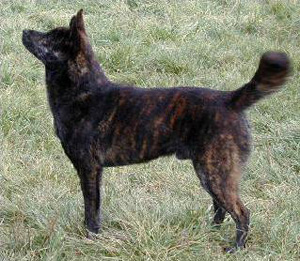
Rock
Photo credit: North American Kai Association
CLICK HERE to View Breeder Listings
Breed Profile
The Kai Ken, also known as the Tora Dog, is an ancient breed of Japanese origin but was not recognized in Japan until 1931 and the breed is still considered very rare. In 1934, the Kai was designated as a “National Treasure” in Japan and is protected by law. The breed was first imported into the U.S. in the early 1990’s. He was originally bred as a hunting dog working with big game hunters of deer and wild boar.
He is a medium sized, muscular, spitz-type dog with the typical wedge-shaped head and prick ears. The tail may be typically curled over the back or carried over the back in a sickle position. He has a harsh, straight coat of medium length and is brindle in colour. The breed’s colouring is a very distinctive characteristic of the breed. Puppies are born black with the brindle markings developing as the pup grows and continues to develop up to about five years. It is believed that the brindle colour was to enable him to blend more easily into his surroundings of trees and rocky surfaces when on the hunt, thus allowing him to sneak up on his prey and protect him from predators.
The Kai is highly intelligent, very brave and agile — They have been known to climb trees and swim in pursuit of their prey. They are natural hunters, good guard dogs and very devoted and loyal to their families. While they may be somewhat reserved toward strangers, Kais are known to be very friendly, generally very good with children, and not aggressive with other dogs.
Health Issues
If you are considering the adoption of a Kai puppy, or any breed, it is very important to be selective in choosing a responsible and reputable breeder. Ensure that the prospective puppy’s parents have all health clearances. Breeding of any dog should not be done until after they have been proven to be free of evidence of significant hereditary diseases. (For more information on selecting a breeder, see the articles on the main General Information page.)
Additional Health Resources:
- Health and Nutrition — Growing section of the Canada’s Guide to Dogs website which includes information on several health and nutrition related issues.
- Canine Health Information Center (CHIC) — Providing a source of health information for owners, breeders, and scientists that will assist in breeding healthy dogs. CHIC is a centralized canine health database jointly sponsored by the AKC/Canine Health Foundation (AKC/CHF) and the Orthopedic Foundation for Animals (OFA).
- AKC Canine Health Foundation — Working towards developing scientific advances in canine health.
- OFA – Companion Animal Eye Registry (CAER)
- Orthopedic Foundation for Animals (OFA)
- Ontario Veterinary College (OVC)
- University of Pennsylvania Hip Improvement Program (PennHip)
- HealthGene — HealthGene Corporation is the leading provider of veterinary DNA diagnostic services in Canada.
- Labgenvet — Laboratory of Veterinary Genetics is a Canadian diagnostic laboratory that offers a comprehensive service of DNA tests for veterinary genetic diseases.
Breed Standards
- UKC Breed Standard for the Kai
- FCI Breed Standard No. 317 – Kai
- The Kai Ken is accepted for recording in the AKC Foundation Stock Service and assigned the Working Group.
Grooming Information
- Grooming — This section of the Canada’s Guide to Dogs website includes tips, articles and information covering all aspects of dog grooming along with a listing of Groomers from across Canada.
Training Resources
It is very important that the Kai be well socialized starting at birth and continuing well into adulthood. He should be exposed to different people, places and situations as much as possible. The Kai is very intelligent and fairly easily trained using positive training methods.
- Training — For training information, see this growing section of the Canada’s Guide to Dogs website for tips, articles, as well as listings of training centres across Canada.
Additional Information
- Clubs, Sports & Activities — For information on the many sports and activities you can get involved in with your dog.
- Working Dogs — The Working Dogs section of the Canada’s Guide to Dogs website provides information and listings of organizations that are involved in various dog jobs, such as Guide Dogs, Therapy Dogs, Police Dogs, Protection Dogs, and much more.
*NOTE 1: CHIC – The Canine Health Information Center “is a database of consolidated health screening results from multiple sources. Co-sponsored by the Orthopedic Foundation for Animals (OFA) and the American Kennel Club (AKC) Canine Health Foundation, CHIC works with parent clubs to identify health screening protocols appropriate for individual breeds. Dogs tested in accordance with the parent club established requirements, that have their results registered and made available in the public domain are issued CHIC numbers.” To learn more, visit: www.caninehealthinfo.org
*NOTE 2: The Fédération Cynologique International (FCI) is the World Canine Organization, which includes 91 members and contract partners (one member per country) that each issue their own pedigrees and train their own judges. The FCI recognizes 344 breeds, with each being the “property” of a specific country. The “owner” countries write the standards of these breeds in co-operation with the Standards and Scientific Commissions of the FCI, and the translation and updating are carried out by the FCI. The FCI is not a breed registry nor does it issue pedigrees.
Breed Listing

Quick Links
Get In Touch
- Email: canadasguidetodogs@gmail.com
- Visit us on Facebook: www.facebook.com/CanadasGuideToDogs
— CanadasGuideToDogs.com is an Amazon Associate as well as a participant in various affiliate programs, as such fees are earned from qualifying purchases.