

Australian Kelpie
Group: Herding Group
Origin: Australia
Height:
- – Male: 20 to 23 inches at the withers;
– Female: 17 to 21 inches at the withers.
Weight:
- – Male: 35 – 45 pounds
– Female: 26 – 36 pounds
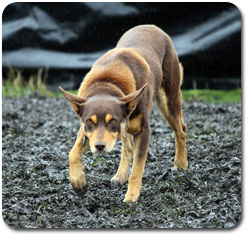
Jed, is a 6 year old Red & Tan Kelpie who competes in sheep dog trials and works on a Cattle Ranch, The Bar Pipe Herford Ranch.
Photo: jkurbatoff@gmail.com
CLICK HERE to View Breeder Listings
Breed Profile
The origin of the Australian Kelpie can be traced to “Working Collies” who were imported into Australia during the 1870s. Hard working with great endurance, he has a highly developed ability to solve problems and can handle thousands of sheep at a time. The Kelpie works in a “gathering style”, using eye, bite and bark to move livestock, working in a style similar to that of the Border Collie. However, he rarely goes flat to the ground but prefers instead to manage the herd in a standing or crouching position. The working Kelpie often works unsupervised, relying on his own instincts to find and gather livestock.
In Australia, the breed is mostly used as a sheep herding dog. In North America, the Kelpie is used as a working dog for all types of livestock, including sheep and cattle. In both Canada and the U.S., the Kelpie has been almost exclusively bred in working environments for more than 80 years. While the Kelpie is not a common breed, there are thousands working in Australia and North America every day.
Keen, active and intelligent, the Kelpie’s temperament should be friendly and alert. The Kelpie is able to adapt to a home environment, however, they are bred to work and thrive on physical and mental activities. Other than herding, the breed also excels at such activities as Agility, Disc Dog, Flyball and other high energy sports and activities. His eagerness to please and intelligence also make him an excellent candidate for obedience work. Provided that the dog is properly socialized around children, Kelpies are generally very good with children of all ages.
The Kelpie is a medium sized, short-coated dog. His coat comes in either black, red, blue, fawn or cream, in solid or with tan markings, with or without minimal white markings. The Kelpie’s appearance is one of an active, muscular dog with effortless and smooth movement.
Health Issues
The working Kelpie is known to be one of the healthiest of dog breeds with very few health problems. Because they had always been bred to work, the Kelpie had to be tough, resilient, fast and with stamina and agility. Those that did not meet these requirements or were not healthy, were not kept. There are no known health problems particular to the breed. Occasional arthritis, cancer, heart failure or kidney failure have been seen, however, these are considered to be during the course of a normal part of life and not regular or common to the breed itself. Joint, coat, ear, eye, feet, or skin problems that are commonly seen in other breeds are not common to the Kelpie.
As with other breeds, however, if you are considering the adoption of a Australian Kelpie puppy, it is still important to be selective in choosing a responsible and reputable breeder. (For more information on selecting a breeder, see the articles on the General Information page.)
Additional Health Resources:
- Health and Nutrition — Growing section of the Canada’s Guide to Dogs website which includes information on several health and nutrition related issues.
- Canine Health Information Center (CHIC) — Providing a source of health information for owners, breeders, and scientists that will assist in breeding healthy dogs. CHIC is a centralized canine health database jointly sponsored by the AKC/Canine Health Foundation (AKC/CHF) and the Orthopedic Foundation for Animals (OFA).
- AKC Canine Health Foundation — Working towards developing scientific advances in canine health.
- OFA – Companion Animal Eye Registry (CAER)
- Orthopedic Foundation for Animals (OFA)
- Ontario Veterinary College (OVC)
- University of Pennsylvania Hip Improvement Program (PennHip)
- HealthGene — HealthGene Corporation is the leading provider of veterinary DNA diagnostic services in Canada.
- Labgenvet — Laboratory of Veterinary Genetics is a Canadian diagnostic laboratory that offers a comprehensive service of DNA tests for veterinary genetic diseases.
Grooming Information
The Australian Kelpie’s short coat requires minimal maintenance to keep it in good condition.
- Grooming — This section of the Canada’s Guide to Dogs website includes tips, articles and information covering all aspects of dog grooming along with a listing of Groomers from across Canada.
Training Resources
The Australian Kelpie is well known for his intelligence. These dogs think things through and have a good ability to solve complex problems. The working Kelpie generally uses his own initiative and is known to work very well in unsupervised conditions. Unlike other breeds, the Kelpie may not wait for a command to act but rather prefers to think for himself and try to understand what needs to be done.
In training the Kelpie, it is important to keep things interesting. This breed is a fast learner but can be easily bored. Firm but fair training methods are best for the Kelpie as he must learn to respect his handler.
- Training — For training information, see this section of the Canada’s Guide to Dogs website for tips, articles, as well as listings of training centres across Canada.
Additional Information
- Origin of the Kelpie
- Is a Dog from the Herding Group Right for you?
- Herding Dogs — A section of the Canada’s Guide to Dogs website which includes training and general information about Herding/Stock Dogs; listing of Stock Dog Clubs and Associations; listing of upcoming shows and events; and more.
- Clubs, Sports & Activities — For information on the many sports and activities you can get involved in with your dog.
- Working Dogs — The Working Dogs section of the Canada’s Guide to Dogs website provides information and listings of organizations that are involved in various dog jobs, such as Guide Dogs, Therapy Dogs, Police Dogs, Protection Dogs, and much more.
*NOTE: The Fédération Cynologique International (FCI) is the World Canine Organization, which includes 91 members and contract partners (one member per country) that each issue their own pedigrees and train their own judges. The FCI recognizes 344 breeds, with each being the “property” of a specific country. The “owner” countries write the standards of these breeds in co-operation with the Standards and Scientific Commissions of the FCI, and the translation and updating are carried out by the FCI. The FCI is not a breed registry nor does it issue pedigrees.
Breed Listing

Quick Links
Get In Touch
- Email: canadasguidetodogs@gmail.com
- Email: info@canadasguidetodogs.com
- Visit us on Facebook: www.facebook.com/CanadasGuideToDogs
— CanadasGuideToDogs.com is an Amazon Associate as well as a participant in various affiliate programs, as such fees are earned from qualifying purchases.