

Komondor
Group: Working Group
Origin: Hungary
Height:
– Males: 27½ inches and over
– Females: 25½ inches and over
Weight:
– Males: Approximately 100 lbs and over at maturity
– Females: Approximately 80 lbs and over at maturity
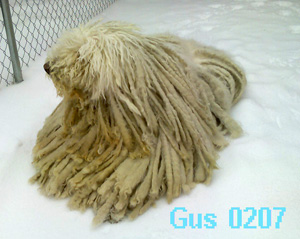
Gus, approx. 7 years old
CLICK HERE to View Breeder Listings
Breed Profile
The Komondor is known as the “King of the Working Dogs” in his native Hungary where he works as a flock guardian. He is believed to be closely related to the Afscharka, a Russian herding breed, and possibly the Puli. The breed was introduced to North America in the early 1930s and is officially recognized by both the Canadian Kennel Club (CKC) and the American Kennel Club (AKC).
The Komondor is a livestock guardian who was originally developed to guard large herds of animals on the open plains, in charge of protecting the herd by himself with no assistance or commands. He is a vigilant guardian of his flock, with a fiercely protective nature, who will fight any predator to the death. Traditionally used to guard sheep, the Komondor has, however, also been used to herd cattle as well as in police work.
Like all livestock guardian dogs, the Komondor is calm and steady under normal conditions. He is reserved with strangers but very affectionate, loyal and extremely devoted to his family. The Komondor will instinctively guard his family, home and posessions without any training. Known for his keen instincts, the Komondor can sense the intentions of anyone in his presence.
The Komondor’s general appearance is one of strength and dignity with a courageous demeanor. He is a large and muscular dog covered with a very distinctive and unusually heavy coat of white cords. This coat serves well to help him blend in with his flock as well as to protect him from weather extremes. The coat colour is always white but not necessarily a pure white. A small amount of cream or buff shading is sometimes seen in puppies. The ideal skin colour is grey though pink skin is acceptable to the breed standard. The puppy coat is fairly soft but shows the tendency to fall into cord-like curls. The young adult coat, or intermediate coat, consists of very short cords which may be hidden by fluff on the outer ends of the cords. The mature coat consists of a dense, soft, wooly undercoat and a coarser outer coat that is either wavy or curly. The coarser outercoat forms permanent, strong cords that are felt-like to the touch.
Health Issues
The Komondor has few genetic or heredity problems. However, as in all large breeds of dogs, incidence of Hip Dysplasia has been seen within the breed. Juvenile Cataracts as well as Entropion — a eye disorder resulting in the curling inwards of either the upper or lower eyelid — are also found in the breed.
Bloat or Gastric Dilation-Torsion syndrome, is a life threatening condition and, though the incidence is no greater in the Komondor than in other large breeds, the condition is an emergency situation that requires immediate veterinary attention. If you are not familiar with this condition, it is absolutely necessary to learn about it and know the symptoms. See First Aid for Bloat for an article describing some of the things you can do if you are faced with this situation.
If you are considering the adoption of a Komondor puppy, or any breed, it is very important to be selective in choosing a responsible and reputable breeder. Ensure that the prospective puppy’s parents have all health clearances, including OFA certification for hips and eye examinations certified by CERF as recommended by the Komondor Club of America. Breeding of any dog should not be done until after they have been proven to be free of evidence of significant hereditary diseases. (For more information on selecting a breeder, see the articles on the main General Information page.)
Additional Health Resources:
- Health and Nutrition — Growing section of the Canada’s Guide to Dogs website which includes information on several health and nutrition related issues.
- Canine Health Information Center (CHIC) — Providing a source of health information for owners, breeders, and scientists that will assist in breeding healthy dogs. CHIC is a centralized canine health database jointly sponsored by the AKC/Canine Health Foundation (AKC/CHF) and the Orthopedic Foundation for Animals (OFA).
- AKC Canine Health Foundation — Working towards developing scientific advances in canine health.
- OFA – Companion Animal Eye Registry (CAER)
- Orthopedic Foundation for Animals (OFA)
- Ontario Veterinary College (OVC)
- University of Pennsylvania Hip Improvement Program (PennHip)
- HealthGene — HealthGene Corporation is the leading provider of veterinary DNA diagnostic services in Canada.
- Labgenvet — Laboratory of Veterinary Genetics is a Canadian diagnostic laboratory that offers a comprehensive service of DNA tests for veterinary genetic diseases.
Grooming Information
The densely corded coat of the Komondor requires regular maintenance and part of regular grooming should be devoted to the inspection for external parasites such as fleas or ticks. Komondors do, however, have extremely sensitive skin to some anit-flea and tick remedies.
Because the Komondor has ears which hang down, regular cleaning is required to keep them clean and hair-free. In addition, thick hair can grow between the pads of the feet which should be kept trimmed.
- Grooming — This section of the Canada’s Guide to Dogs website includes tips, articles and information covering all aspects of dog grooming along with a listing of Groomers from across Canada.
Training Resources
The Komondor is an intelligent and independent thinker who requires early obedience training, starting as young as eight weeks of age. This breed can become obstinate when bored, so it is very important that training sessions be varied and upbeat. Praise, consistency and patience are key. Due to his natural guarding instincts, socialization is also extemely important with the Komondor. He should be exposed to new situations, people and other pets as a young puppy.
- Starting the LGD Pup by Catherine de la Cruz
- Training — For training information, see this growing section of the Canada’s Guide to Dogs website for tips, articles, as well as listings of training centres across Canada.
Additional Information
- Working Livestock Guardian Dogs (LGD) — What is their Job?
- Livestock Guardian Dogs: Their Current Use Worldwide by Robin Rigg
- Clubs, Sports & Activities — For information on the many sports and activities you can get involved in with your dog.
- Working Dogs — The Working Dogs section of the Canada’s Guide to Dogs website provides information and listings of organizations that are involved in various dog jobs, such as Guide Dogs, Therapy Dogs, Police Dogs, Protection Dogs, and much more.
*NOTE 1: CHIC – The Canine Health Information Center “is a database of consolidated health screening results from multiple sources. Co-sponsored by the Orthopedic Foundation for Animals (OFA) and the American Kennel Club (AKC) Canine Health Foundation, CHIC works with parent clubs to identify health screening protocols appropriate for individual breeds. Dogs tested in accordance with the parent club established requirements, that have their results registered and made available in the public domain are issued CHIC numbers.” To learn more, visit: www.caninehealthinfo.org
*NOTE 2: The Fédération Cynologique International (FCI) is the World Canine Organization, which includes 91 members and contract partners (one member per country) that each issue their own pedigrees and train their own judges. The FCI recognizes 344 breeds, with each being the “property” of a specific country. The “owner” countries write the standards of these breeds in co-operation with the Standards and Scientific Commissions of the FCI, and the translation and updating are carried out by the FCI. The FCI is not a breed registry nor does it issue pedigrees.
Breed Listing


Quick Links
Get In Touch
- Email: canadasguidetodogs@gmail.com
- Email: info@canadasguidetodogs.com
- Visit us on Facebook: www.facebook.com/CanadasGuideToDogs
— CanadasGuideToDogs.com is an Amazon Associate as well as a participant in various affiliate programs, as such fees are earned from qualifying purchases.