

Finnish Lapphund
Origin: Finland
Height:
- – Males: 18 to 20½ inches at the withers
– Females: 16 to 18½ inches at the withers
Other Name: Suomenlapinkoira

CLICK HERE to View Breeder Listings
Breed Profile
The Finnish Lapphund is believed to be the original native breed used by the Sami people to hunt reindeer in the region known as Lapland. Over time, the breed gradually changed from a guarding and hunting dog to a reindeer herder. For centuries, the Sami people depended on the help of the Spitz dogs and, eventually, these herding dogs developed into three breeds: the Swedish Lapphund, the Lapponian Herder (Lapinporokoira), and the Finnish Lapphund. The first breed standard was accepted by the Finnish Kennel Club in 1945 with the breed known as the Lapponian Shepherd Dog. At this time, there were two coat types — a short and long coated dog. By 1967, the long coated dog was given a separate standard and officially named the Finnish Lapphund or Suomenlapinkoira and the short-haired breed was named the Lapponian Herder or Lapinporokoira. The breed was first introduced into the United States in 1987 and was recognized by the United Kennel Club in 1994. Today, in Finland, the breed is among the 15 most popular breeds with a steady increase in popularity throughout the 1990s.
The Finnish Lapphund is intelligent, independent, affectionate, adaptable and always willing to work. He has natural herding instincts and makes an excellent watchdog. A fast learner and easily trained, the Lapphund enjoys having a job to do and does very well in many dog sports.
In appearance, the Finnish Lapphund resembles many of the Spitz-type dogs with a profuse double coat, a tail that is set high and curls over the back when the dog is moving. His outer-coat is long, straight and coarse and the undercoat is very thick. His ears are either prick or may have folded tips.
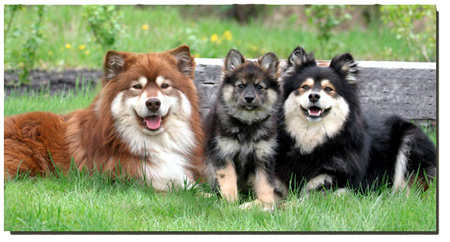
Sugarok Buster Brown, Sugarok Northern Sky and UKC Ch. Sugarok Amazing Grace
Photo courtesy of Finnish Lapphund Club of Canada
Health Issues
The Finnish Lapphund is long lived with an average life expectancy of 13 to 15 years and is known as one of the healthiest breeds in Finland.
If you are considering the adoption of a Finnish Lapphund puppy, or any breed, it is very important to be selective in choosing a responsible and reputable breeder. Ensure that the prospective puppy’s parents have all health clearances. Breeding of any dog should not be done until after they have been proven to be free of evidence of significant hereditary diseases. (For more information on selecting a breeder, see the articles on the General Information page.)
Recommended Health Screening:
For the Finnish Lapphund, the CHICNOTE 1 database includes health screenings for:
- Hip Dysplasia
- Progressive Retinal Atrophy (PRA) DNA Test
- Eye Examination by a board Ophthalmologist
- Also listed as Optional: Elbow Dysplasia; Patellar Luxation
Additional Health Resources:
- Health and Nutrition — Growing section of the Canada’s Guide to Dogs website which includes information on several health and nutrition related issues.
- Canine Health Information Center (CHIC) — Providing a source of health information for owners, breeders, and scientists that will assist in breeding healthy dogs. CHIC is a centralized canine health database jointly sponsored by the AKC/Canine Health Foundation (AKC/CHF) and the Orthopedic Foundation for Animals (OFA).
- AKC Canine Health Foundation — Working towards developing scientific advances in canine health.
- OFA – Companion Animal Eye Registry (CAER)
- Orthopedic Foundation for Animals (OFA)
- Ontario Veterinary College (OVC)
- University of Pennsylvania Hip Improvement Program (PennHip)
- HealthGene — HealthGene Corporation is the leading provider of veterinary DNA diagnostic services in Canada.
- Labgenvet — Laboratory of Veterinary Genetics is a Canadian diagnostic laboratory that offers a comprehensive service of DNA tests for veterinary genetic diseases.
Breed Standards
- CKC Breed Standard – from the Finnish Lapphund Club of Canada
- AKC Breed Standard
- UKC Breed Standard
- The Kennel Club (U.K.) Breed Standard
- F.C.I. Breed Standard No. 189
Grooming Information
The Finnish Lapphund’s thick coat requires regular brushing and the occasional bath.
- Grooming — This section of the Canada’s Guide to Dogs website includes tips, articles and information covering all aspects of dog grooming along with a listing of Groomers from across Canada.
Training Resources
- Training — For training information, see this growing section of the Canada’s Guide to Dogs website for tips, articles, as well as listings of training centres across Canada.
Additional Information
- Is a Dog from the Herding Group Right for You?
- Clubs, Sports & Activities — For information on the many sports and activities you can get involved in with your dog.
- Working Dogs — The Working Dogs section of the Canada’s Guide to Dogs website provides information and listings of organizations that are involved in various dog jobs, such as Guide Dogs, Therapy Dogs, Police Dogs, Protection Dogs, and much more.
*NOTE 1: CHIC – The Canine Health Information Center “is a database of consolidated health screening results from multiple sources. Co-sponsored by the Orthopedic Foundation for Animals (OFA) and the American Kennel Club (AKC) Canine Health Foundation, CHIC works with parent clubs to identify health screening protocols appropriate for individual breeds. Dogs tested in accordance with the parent club established requirements, that have their results registered and made available in the public domain are issued CHIC numbers.” To learn more, visit: www.caninehealthinfo.org
*NOTE 2: The Fédération Cynologique International (FCI) is the World Canine Organization, which includes 91 members and contract partners (one member per country) that each issue their own pedigrees and train their own judges. The FCI recognizes 344 breeds, with each being the “property” of a specific country. The “owner” countries write the standards of these breeds in co-operation with the Standards and Scientific Commissions of the FCI, and the translation and updating are carried out by the FCI. The FCI is not a breed registry nor does it issue pedigrees.
Breed Listing

Quick Links
Get In Touch
- Email: canadasguidetodogs@gmail.com
- Email: info@canadasguidetodogs.com
- Visit us on Facebook: www.facebook.com/CanadasGuideToDogs
— CanadasGuideToDogs.com is an Amazon Associate as well as a participant in various affiliate programs, as such fees are earned from qualifying purchases.