

Mastiff
Group: Working Group
Origin: Great Britain
Height:
– Males: Min 30 in (76 cm) at the shoulder.
– Females: Min 27½ in (70 cm) at the shoulder.
Weight:
– Males: From 175 lbs (80 kg) to 230 lbs (106 kg).
– Females: From 130 lbs (59 kg) to 190 lbs (86 kg).
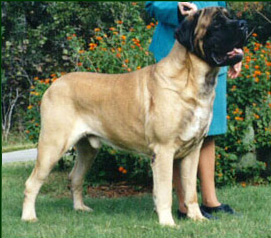
Am.Can Ch. Caledonia Paddy Wagon “Sherlock”
Photo: Monolithic Mastiffs
CLICK HERE to View Breeder Listings
Note: The general term “mastiff” is used to refer to several breeds around the world. The Mastiff as a specific breed originated in England over 2,000 years ago and is also known as the English Mastiff.
Breed Profile
The Mastiff, also known as the English Mastiff and Old English Mastiff, is one of the heaviest breeds — an adult male can weigh more than 200 pounds. He is massive, powerful, stately and noble in appearance and he is known as the gentle giant of the dog world.
The Mastiff is a versatile working dog. His great strength was once used to turn water wheels, pull carts and carry heavy loads on his back. He was also orginally used as a guardian and fighting dog. Today, Mastiffs are excellent companions and family members. They can be seen participating in various activities such as carting, tracking, weight pulling, obedience competition and conformation. They are also used as Therapy Dogs and in Search and Rescue.
The Mastiff is watchful, self-confident and patient. He is very devoted to his family and will protect both his family and property in a calm and dignified manner. While some Mastiffs tend to be aloof with strangers, others are fairly friendly. However, the breed has a strong guarding instinct and will always be very watchful of strangers entering the home and/or around his family members. His good nature, patience and calm, steady demeanor also means that he is generally excellent with children. The Mastiff needs human companionship and is not a dog to be left alone for long periods of time.
Physically, the Mastiff is massive, heavy boned, and muscular. He gives an overall impression of grandeur, power and dignity. Although the Mastiff grows at a tremendous rate for the first 12 months, he does not physically or mentally mature until the age of three or four years. His outer coat is moderately coarse and the under coat is dense, short and close lying. The coat colour is either apricot, silver fawn or dark fawn-brindle. The muzzle, nose and ears are always dark in colour, the darker the better.
Did you Know?
- All Mastiffs slobber. The amount varies from one dog to the next. While some slobber only when eating, drinking or when they are hot; others seem to slobber constantly.
- Another characteristic of the breed is snoring. Snoring is genetic and caused by a long soft palate, so some Mastiffs snore occasionally and others snore very loudly and often.
- According to the MCOA, the Guinness Book of Records holder for the world’s largest dog is a Mastiff named Zorba. In 1989, when he was 8 years old, Zorba weighed 343 pounds and measured 37 inches at the shoulder. From the tip of his nose to the tip of his tail, Zorba was 8 feet 3 inches in length.
A Brief History of the Mastiff
There are several theories as to where the Mastiff breed originated but it is generally believed that the British created the breed as he is known today. Legends and folklore abound regarding the breed’s ancestry and there is evidence of Mastiff-like dogs dating as far back as 2500 BC in the mountains of Asia.
Mastiffs were used to guard castles and estates, as war dogs accompanying soldiers into battle and, when the Romans invaded Britain, they took dogs back to Italy and used them to guard property and prisoners as well as to fight in arenas. During the Elizabethan era, Mastiffs were used to fight large game, including bears and tigers, usually for the entertainment of the Queen.
By the mid-1800s, dog showing had become popular in England and the first recorded pedigrees for the Mastiff had begun with the Kennel Club of England. By the late 1800s, Mastiffs were being imported into North America where they were often used as plantation guards.
During the First and Second World Wars, Mastiffs were used to pull munitions carts on the front lines. During World War I, the breed started to decline in England and by the 1920s, the breed was almost extinct in that country — It was considered unpatriotic to keep dogs who ate as much in a day as a soldier and, as a result, entire kennels were put down. At the end of World War II, British fanciers began to import stock from Canada and the U.S. in order to revive the breed. Today, the Mastiff breed is well established with the greatest numbers likely being in the U.S.
Additional Reading:
- History of the Mastiff — From the Mastiff Club of America
Health Issues
The average life span for the Mastiff is 6-10 years. However, some live to be 13 or 14 and a few have lived to the age of 17 years. Like all breeds, the Mastiff is susceptible to certain hereditary and non-hereditary health disorders, including: eye diseases, Hip Dysplasia, Elbow Dysplasia, Cancer, Aortic Stenosis and other heart disease, Epilepsy, Hypothyroidism, vonWillebrand’s Disease, Gastric Torsion (Bloat) and others.
If you are considering a Mastiff puppy, or any breed, it is very important to be selective in choosing a responsible and reputable breeder. Ensure that the prospective puppy’s parents have all health clearances. Breeding of any dog should not be done until after they have been proven to be free of evidence of significant hereditary diseases. (For more information on selecting a breeder, see the articles on the General Information page.)
The Canadian Mastiff Club Code of Ethics lists required testing for breeding stock as well as encourages club members to do further testing prior to breeding.
Additional Health Resources:
- First Aid for Bloat Prepared by: Siefried Zahn D.V.M — This article uses a Great Dane as an example, however, it can be applied to other breeds. Please note, that this condition is an emergency, requiring immediate veterinary action. The condition is most often found in large, deep chested dog breeds and anyone owning a deep chested breed should be prepared to handle the emergency procedures necessary, including having readily available the name and phone number of emergency clinics and/or after-hours Veterinarians.
- Mastiff Health — From the Mastiff Club of America
The MCOA Health Committee recommends that all Mastiff breeders provide their puppy buyers with a list of health problems found in Mastiffs such as found on this listing. If you are considering getting a Mastiff, you should review this first. - Doc Rob’s Library of Mastiff Medicine — Includes articles written by Robin M. Smith DVM, with many being Mastiff specific. The following articles are part of this library:
- Canine Inherited Disorders Database — Mastiff
- Health Matters — The Old English Mastiff Club
- Canine Health Information Center (CHIC) — Mastiff Breeds Requirements — Providing a source of health information for owners, breeders, and scientists that will assist in breeding healthy dogs. CHIC is a centralized canine health database jointly sponsored by the AKC/Canine Health Foundation (AKC/CHF) and the Orthopedic Foundation for Animals (OFA).
- Health and Nutrition — Growing section of the Canada’s Guide to Dogs website which includes information on several health and nutrition related issues.
- Canine Health Information Center (CHIC) — Providing a source of health information for owners, breeders, and scientists that will assist in breeding healthy dogs. CHIC is a centralized canine health database jointly sponsored by the AKC/Canine Health Foundation (AKC/CHF) and the Orthopedic Foundation for Animals (OFA).
- AKC Canine Health Foundation — Working towards developing scientific advances in canine health.
- Companion Animal Eye Registry (CAER)
- Orthopedic Foundation for Animals (OFA)
- Ontario Veterinary College (OVC)
- University of Pennsylvania Hip Improvement Program (PennHip)
- HealthGene — HealthGene Corporation is the leading provider of veterinary DNA diagnostic services in Canada.
- Labgenvet — Laboratory of Veterinary Genetics is a Canadian diagnostic laboratory that offers a comprehensive service of DNA tests for veterinary genetic diseases.
Grooming Information
The Mastiff’s short coat requires minimal grooming with a brush a few times a week and the occasional bath, his coat will be kept looking good. Other grooming needs such as cleaning of ears and teeth and trimming nails should be done regularly.
- Grooming your Mastiff
- Grooming — This section of the Canada’s Guide to Dogs website includes tips, articles and information covering all aspects of dog grooming along with a listing of Groomers from across Canada.
Training Resources
The Mastiff is a very sensitive dog and early socialization to new situations is a must for this breed. If not properly socialized, he may become shy, nervous or show signs of aggression. Basic training should also start at a young age for the Mastiff puppy.
- Training your Mastiff — from Mastiffweb.com
- Training — For training information, see this growing section of the Canada’s Guide to Dogs website for tips, articles, as well as listings of training centres across Canada.
Additional Information
- Mastiffs and Children — by Sharon Medforth
- Choosing a Breeder — by Mrs. Bev Molloy, Banda Mastiffs
- Mastiff Breed FAQ — From the Mastiff Club of America
- Mastiff Stud Dog Register
- Mastiffweb.com — The Great Home of the English Mastiff on the Internet — Excellent source of information for the Mastiff breed as well as a message board.
- Clubs, Sports & Activities — For information on the many sports and activities you can get involved in with your dog.
- Working Dogs — The Working Dogs section of the Canada’s Guide to Dogs website provides information and listings of organizations that are involved in various dog jobs, such as Guide Dogs, Therapy Dogs, Police Dogs, Protection Dogs, and much more.


*NOTE 1: CHIC – The Canine Health Information Center “is a database of consolidated health screening results from multiple sources. Co-sponsored by the Orthopedic Foundation for Animals (OFA) and the American Kennel Club (AKC) Canine Health Foundation, CHIC works with parent clubs to identify health screening protocols appropriate for individual breeds. Dogs tested in accordance with the parent club established requirements, that have their results registered and made available in the public domain are issued CHIC numbers.” To learn more, visit: www.caninehealthinfo.org
*NOTE 2: The Fédération Cynologique International (FCI) is the World Canine Organization, which includes 91 members and contract partners (one member per country) that each issue their own pedigrees and train their own judges. The FCI recognizes 344 breeds, with each being the “property” of a specific country. The “owner” countries write the standards of these breeds in co-operation with the Standards and Scientific Commissions of the FCI, and the translation and updating are carried out by the FCI. The FCI is not a breed registry nor does it issue pedigrees.

Quick Links
Get In Touch
- Email: canadasguidetodogs@gmail.com
- Visit us on Facebook: www.facebook.com/CanadasGuideToDogs
— CanadasGuideToDogs.com is an Amazon Associate as well as a participant in various affiliate programs, as such fees are earned from qualifying purchases.