

Papillon
Group: Toy Group
Origin: France, Belgium
Height: 8 to 11 inches (20 to 28 cm)
In European countries the Papillon is known as “Épagneul nain continental” or “Continental Toy Spaniel” with two breed types: the Phalène which has drop-ears and the Papillon with erect-ears.

CLICK HERE to View Breeder Listings
Breed Profile
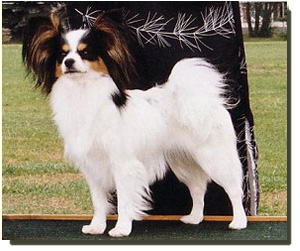
The Papillon is a small, elegant, happy, alert and friendly Toy dog. A wonderful family companion, neither shy nor aggressive, but very protective of his family and home. Despite his elegant and dainty appearance, he is a good watchdog who will always alert to strangers.
The Papillon is very trainable and is seen participating in several areas of competition, including the show ring, obedience, agility, tracking and even herding. In addition, his temperament and need for human companionship make him an ideal candidate to work in such areas as Therapy and Service Dog.
The Papillon’s distinguishing characteristic from other breeds is the butterfly-like ears. There are two varieties: the erect and drop type. Both types should be large with rounded tips and set on the sides and toward the back of the head. Ears of the erect type move like the spread wings of a butterfly. The drop-ear type, known as the Phalène (French for a moth that droops its wings) are similar to the erect type but are carried drooping and completely down. It should be noted also that both drop-eared and erect-eared types can be born from the same litter.
He has an abundant amount of long, fine, silky hair with a profuse frill on the chest. His colouring is always parti-colour or white with patches of any colour. On his head, a colour other than white should cover both ears and eyes and a white blaze on the face helps to emphasize the butterfly look.
A Brief History of the Papillon
The Papillon, previously known as the “Dwarf Spaniel”, is believed to have originated in France but became very popular in both Italy and Spain and was a favourite among the ladies of the court around the 17th and 18th centuries. The breed is one of the oldest of the toy breeds. The breed’s name was given in France due to the distinctive ears which resemble the wings of a butterfly — Papillon is the french word for butterfly.
Health Issues
Papillons are generally a healthy and long-lived breed, often remaining active and playful well into their teens. However, like all breeds, they have been known to have some genetic problems. If you are considering the adoption of a Papillon puppy, or any breed, it is very important to be selective in choosing a responsible and reputable breeder. Ensure that the prospective puppy’s parents have all health clearances. Breeding of any dog should not be done until after they have been proven to be free of evidence of significant hereditary diseases. (For more information on selecting a breeder, see the articles on the main General Information page.)
Of note: The Papillon is among the more anesthetic-sensitive breeds. Always discuss this with your Veterinarian prior to any surgery.
Additional Health Resources:
- Papillon Club of America Health & Genetics
- Collapsed Trachea: The Health Problem Every Owner of a Small Dog Should Understand
- Health and Nutrition — Growing section of the Canada’s Guide to Dogs website which includes information on several health and nutrition related issues.
- Canine Health Information Center (CHIC) — Papillon Breeds Requirements — Providing a source of health information for owners, breeders, and scientists that will assist in breeding healthy dogs. CHIC is a centralized canine health database jointly sponsored by the AKC/Canine Health Foundation (AKC/CHF) and the Orthopedic Foundation for Animals (OFA).
- AKC Canine Health Foundation — Working towards developing scientific advances in canine health.
- Canine Eye Registration Foundation (CERF)
- Orthopedic Foundation for Animals (OFA)
- Ontario Veterinary College (OVC)
- University of Pennsylvania Hip Improvement Program (PennHip)
- HealthGene — HealthGene Corporation is the leading provider of veterinary DNA diagnostic services in Canada.
- Labgenvet — Laboratory of Veterinary Genetics is a Canadian diagnostic laboratory that offers a comprehensive service of DNA tests for veterinary genetic diseases.
Breed Standards
- CKC Breed Standard
- AKC Breed Standard
- UKC Breed Standard
- The Kennel Club (U.K.) Breed Standard
- FCI Breed Standard No. 77 – Continental Toy Spaniel
- Seminar: Judging the Papillon — Online seminar originally written for the Judges-L list as part of their ongoing educational seminars for judges. “The seminar was conceived with the idea that a discussion of the AKC Standard and comments from breeders would help elucidate the standard for those interested in the breed.”
Grooming Information
Although the Papillon is often referred to as the “wash and wear” dog, this does not mean that no grooming is required. The Papillon’s long silky hair should be brushed and combed daily.
- Grooming — This section of the Canada’s Guide to Dogs website includes tips, articles and information covering all aspects of dog grooming along with a listing of Groomers from across Canada.
Training Resources
- Toy Breeds — Housebreaking
- Training — For training information, see this growing section of the Canada’s Guide to Dogs website for tips, articles, as well as listings of training centres across Canada.
Additional Information
- Papfriends — Papillon Mailing List
- 10 Things to Consider Before Getting a Dog
- Toy Breeds — Selecting the Perfect Pooch
- Clubs, Sports & Activities — For information on the many sports and activities you can get involved in with your dog.
- Working Dogs — The Working Dogs section of the Canada’s Guide to Dogs website provides information and listings of organizations that are involved in various dog jobs, such as Guide Dogs, Therapy Dogs, Police Dogs, Protection Dogs, and much more.
*NOTE 1: CHIC – The Canine Health Information Center “is a database of consolidated health screening results from multiple sources. Co-sponsored by the Orthopedic Foundation for Animals (OFA) and the American Kennel Club (AKC) Canine Health Foundation, CHIC works with parent clubs to identify health screening protocols appropriate for individual breeds. Dogs tested in accordance with the parent club established requirements, that have their results registered and made available in the public domain are issued CHIC numbers.” To learn more, visit: www.caninehealthinfo.org
*NOTE 2: The Fédération Cynologique International (FCI) is the World Canine Organization, which includes 91 members and contract partners (one member per country) that each issue their own pedigrees and train their own judges. The FCI recognizes 344 breeds, with each being the “property” of a specific country. The “owner” countries write the standards of these breeds in co-operation with the Standards and Scientific Commissions of the FCI, and the translation and updating are carried out by the FCI. The FCI is not a breed registry nor does it issue pedigrees.
Breed Listing

Quick Links
Get In Touch
- Email: canadasguidetodogs@gmail.com
- Visit us on Facebook: www.facebook.com/CanadasGuideToDogs
— CanadasGuideToDogs.com is an Amazon Associate as well as a participant in various affiliate programs, as such fees are earned from qualifying purchases.