

Pug
Group: Toys
Origin: China
Weight: 14-18 lbs. (6.3 – 8.1 kgs)
CLICK HERE to View Breeder Listings
Breed Profile
The Pug is one of the oldest breeds of dogs. The breed is believed to be of Chinese origin and shares similarities to the Pekingese. They were prized possessions of the Emperors of China and lived in a luxurious setting and at times were even guarded by soldiers. By the 15th century, the breed was imported to several European countries and, even today, they are a favourite with royalty and discerning people all over the world.
The Pug is an excellent companion as well as a fairly good watchdog who will alert to the presence of strangers. Primarily bred for human companionship, the Pug is extremely people oriented and should not be left alone for extended periods of time. Today, Pugs are seen in Obedience competition, working as Therapy Dogs as well as Hearing Dogs.
The Pug is intelligent, even-tempered, and can be a bit stubborn. He has a loving, outgoing, and playful disposition, wanting nothing more than to please his family.
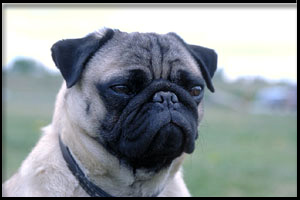
The Pug’s coat is either solid black, silver fawn or apricot fawn and is fine, short, smooth and glossy. The fawn coloured Pugs have black masks and ears (as seen in the photo above). The black Pug is a glossy jet black.
Health Issues
The Pug is generally a healthy and hearty breed with a lifespan well into the mid to upper teens. However, like all breeds of dogs, there are some health problems seen in Pugs. One common problem with the Pug is obesity and it is therefore important for the dog’s overall health to keep his weight in check. The Pug is a brachycephalic breed and should not be left outdoors! Heat and high humidity can easily cause death in this breed due to the flatness of their faces. They may have trouble breathing and should be kept cool and exercised carefully during the summer months. The Brachycephalic syndrome can also involve having pinched nostrils and an elongated soft palate. Signs of this include excessive snoring and gasping for breath.
Additional health concerns include, but are not limited to:
- Pug Dog Encephalitis (PDE) — PDE is a fatal inflammatory brain disease usually seen in young dogs. Signs of the disorder can happen very rapidly, within a few days or weeks, and include seizures, circling, blindness, coma and finally death. It is believed to be of a hereditary nature and the Pug Dog Club of America, along with the AKC Canine Health Foundation, are sponsoring research projects to learn more about the disease.
- Epilepsy — Pugs have been known to have idiopathic epilepsy, or seizures for no known reason. Generally, medication can control the seizures quite successfully.
- Eye Problems — Pugs can have some serious eye problems including Corneal Ulcers, Dry Eye and Pigmentary Keratitis (PK) — this is commonly seen in Pugs and quite often occur together — Dystichia — extra eye lashes that rub against the eye causing irritation and sometimes ulcers.
- Hemi-Vertebra — A condition which involves deformed, misshaped vertebrae of the spine. It is a problem commonly seen in short-faced breeds, including the Pug. Signs of the disorder include a staggering, uncoordinated and weak gait and generally occurs in puppies between 4 to 6 months of age. The disease can get progressively worse and may lead to paralysis.
- Hip Dysplasia — Pugs are second only to Bulldogs in the amount of Hip Dysplasia seen in the breed. However, unlike some of the large and giant breeds affected with Hip Dysplasia, most Pugs can lead normal, healthy lives without requiring surgery.
- Legg-Perthes Calves Disease — This is a common disease seen in many of the toy breeds which, like Hip Dysplasia, involves the hip joint. In Legg-Perthes, the blood supply to the head of the femur is compromised.
- Luxating Patellas — Another common disorder seen in toy breeds and some larger breeds. In affected dogs, the kneecap or patella slides to the side and the joint is unstable, rather than riding up and down as it usually should.
If you are considering the adoption of a Pug puppy, or any breed, it is very important to be selective in choosing a responsible and reputable breeder. Ensure that the prospective puppy’s parents have all health clearances. Breeding of any dog should not be done until after they have been proven to be free of evidence of significant hereditary diseases. (For more information on selecting a breeder, see the articles on the main General Information page.)
Additional Health Resources:
- Pug Dog Club of America — Pug Health Guide
- Collapsed Trachea: The Health Problem Every Owner of a Small Dog Should Understand
- Canine Health Information Center (CHIC) — Standard Poodle Requirements — Providing a source of health information for owners, breeders, and scientists that will assist in breeding healthy dogs. CHIC is a centralized canine health database jointly sponsored by the AKC/Canine Health Foundation (AKC/CHF) and the Orthopedic Foundation for Animals (OFA).
- Health and Nutrition — Growing section of the Canada’s Guide to Dogs website which includes information on several health and nutrition related issues.
- AKC Canine Health Foundation — Working towards developing scientific advances in canine health.
- Canine Eye Registration Foundation (CERF)
- Orthopedic Foundation for Animals (OFA)
- Ontario Veterinary College (OVC)
- University of Pennsylvania Hip Improvement Program (PennHip)
- HealthGene — HealthGene Corporation is the leading provider of veterinary DNA diagnostic services in Canada.
- Labgenvet — Laboratory of Veterinary Genetics is a Canadian diagnostic laboratory that offers a comprehensive service of DNA tests for veterinary genetic diseases.
Breed Standards
- CKC Breed Standard
- AKC Breed Standard
- UKC Breed Standard
- Illustrated Breed Standard — From the Pug Dog Club of America
- The Kennel Club (U.K.) Breed Standard
- FCI Breed Standard No. 253

Grooming Information
The Pug’s smooth coat requires minimal grooming but areas that do require regular maintenance include: nails should be kept trimmed; ears should be checked and cleaned regularly; the nose roll and wrinkles along the face need to be kept clean; and teeth need to brushed and maintained as much as possible.
- Grooming — This section of the Canada’s Guide to Dogs website includes tips, articles and information covering all aspects of dog grooming along with a listing of Groomers from across Canada.
Training Resources
- Training — For training information, see this growing section of the Canada’s Guide to Dogs website for tips, articles, as well as listings of training centres across Canada.
Additional Information
- Clubs, Sports & Activities — This section of the Canada’s Guide to Dogs website covers several sports and activities and also includes listings of non-breed specific Dog Clubs from across Canada.
- Working Dogs — The Working Dogs section of the Canada’s Guide to Dogs website provides information and listings of organizations that are involved in various dog jobs, such as Guide Dogs, Therapy Dogs, Police Dogs, Protection Dogs, and much more.
- Pug Pedigree Database
*NOTE 1: CHIC – The Canine Health Information Center “is a database of consolidated health screening results from multiple sources. Co-sponsored by the Orthopedic Foundation for Animals (OFA) and the American Kennel Club (AKC) Canine Health Foundation, CHIC works with parent clubs to identify health screening protocols appropriate for individual breeds. Dogs tested in accordance with the parent club established requirements, that have their results registered and made available in the public domain are issued CHIC numbers.” To learn more, visit: www.caninehealthinfo.org
*NOTE 2: The Fédération Cynologique International (FCI) is the World Canine Organization, which includes 91 members and contract partners (one member per country) that each issue their own pedigrees and train their own judges. The FCI recognizes 344 breeds, with each being the “property” of a specific country. The “owner” countries write the standards of these breeds in co-operation with the Standards and Scientific Commissions of the FCI, and the translation and updating are carried out by the FCI. The FCI is not a breed registry nor does it issue pedigrees.
Breed Listing


Quick Links
Get In Touch
- Email: canadasguidetodogs@gmail.com
- Visit us on Facebook: www.facebook.com/CanadasGuideToDogs
— CanadasGuideToDogs.com is an Amazon Associate as well as a participant in various affiliate programs, as such fees are earned from qualifying purchases.