

Scottish Terrier
Group: Terrier
Origin: Great Britain
Height: 10 inches (25 cm)
Weight: 18 to 22 lbs (8-10 kg)
CLICK HERE to View Breeder Listings
Breed Profile
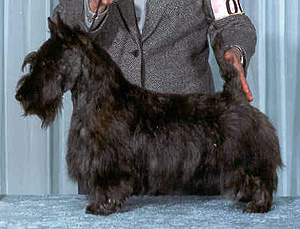
The Scottish Terrier originated sometime during the 1500 and 1600’s and is one of the oldest and most recognized of the Terrier breeds. Originally he was used to hunt vermin and bred to be fearless. Today, the well raised Scottish Terrier is a loyal, loving and playful companion. He is alert and spirited yet stable and easy-going. He is an excellent watch dog and adaptable to most living environments. He thrives on human companionship and a Scottie who is raised with children will be very devoted to them.
The Scottie’s physical appearance gives the impression of power. He is very square and solidly built, often referred to as a big dog in a small package. He has a short outer-coat that is hard and wiry and a dense, soft undercoat. His hair is longer on the muzzle and over the eyes, forming a beard and eyebrows. His colours are either grey, brindle, black or wheaten. His coat is non-shedding and quite often will not trigger allergic reactions for those who suffer from allergies.
Health Issues
The Scottish Terrier breed is generally very healthy and not susceptible to many of the genetic health problems found in other breeds. However, as in all breeds, there are some genetic health issues that may be of concern. The following is a brief listing of some of these:
- Scottie Cramp — The most common hereditary disorder found in the Scottish Terrier breed. It is a permanent condition, but it does not worsen with age. Most dogs affected with Scottie Cramp still make wonderful companions, able to share virtually all activities.
- von Willebrand’s Disease — vWD is a blood disorder, a deficiency in clotting factor VIII antigen. Dogs affected by the disease do not effectively utilize their platelets for blood clotting and therefore are more likely to have excessive bleeding episodes upon injury. This is similar to hemophilia in humans.
- Cushing’s Syndrome — Cushing’s disease is the result of the overproduction of cortison, a natural steriod hormone, by the adrenal glands. In the majority of cases, the disease is caused by a lesion in the pituitary gland at the base of the brain that overstimulates the adrenals, while in about 20 percent of cases one of the adrenal glands itself will have a tumor that excretes cortisol independent of what’s happening in the body. About half of those tumors are malignant and spread, and about half of them are benign and generally remain small. It is unknown whether there is an inherited predisposition to Cushing’s Syndrome in Scottish Terriers.
- Hypothyroidism — Canine Hypothyroidism is the most commonly diagnosed hormonal disease found in dogs. The term hypothyroidism simply means the underproduction of thyroxin, the hormone produced by the thyroid gland.
- Epilepsy — Canine Epilepsy is a chronic condition characterized by recurrent seizures. Seizures are the result of muscle responses to an abnormal nerve-signal burst from the brain. In recent years, there appears to be an increase of reported seizures in Scottish Terriers.
- Craniomandibular Osteopathy — CMO is an inherited disorder usually appearing between the age of four to seven months. It is an abnormal growth of the bone of the lower jaw but normally, as the dog matures, this abnormality abates and is often undetectable in the adult dog.
For additional information on these and other health issues, please see the Health & Nutrition section of the Canada’s Guide to Dogs website as well as Genetic Health Issues from the Scottish Terrier Club of America.
If you are considering the adoption of a Scottish Terrier puppy, or any breed, it is very important to be selective in choosing a responsible and reputable breeder. Ensure that the prospective puppy’s parents have all health clearances. Breeding of any dog should not be done until after they have been proven to be free of evidence of significant hereditary diseases. (For more information on selecting a breeder, see the articles on the main General Information page.)
Additional Health Resources:
- Canine Health Information Center (CHIC) — Providing a source of health information for owners, breeders, and scientists that will assist in breeding healthy dogs. CHIC is a centralized canine health database jointly sponsored by the AKC/Canine Health Foundation (AKC/CHF) and the Orthopedic Foundation for Animals (OFA).
- AKC Canine Health Foundation — Working towards developing scientific advances in canine health.
- Canine Eye Registration Foundation (CERF)
- Orthopedic Foundation for Animals (OFA)
- Ontario Veterinary College (OVC)
- University of Pennsylvania Hip Improvement Program (PennHip)
- HealthGene — HealthGene Corporation is the leading provider of veterinary DNA diagnostic services in Canada.
- Labgenvet — Laboratory of Veterinary Genetics is a Canadian diagnostic laboratory that offers a comprehensive service of DNA tests for veterinary genetic diseases.
Grooming Information
- Grooming — This section of the Canada’s Guide to Dogs website includes tips, articles and information covering all aspects of dog grooming along with a listing of Groomers from across Canada.
Training Resources
- Training — For training information, see this growing section of the Canada’s Guide to Dogs website for tips, articles, as well as listings of training centres across Canada.
Additional Information
- Clubs, Sports & Activities — For information on the many sports and activities you can get involved in with your dog.
- Working Dogs — The Working Dogs section of the Canada’s Guide to Dogs website provides information and listings of organizations that are involved in various dog jobs, such as Guide Dogs, Therapy Dogs, Police Dogs, Protection Dogs, and much more.
*NOTE 1: CHIC – The Canine Health Information Center “is a database of consolidated health screening results from multiple sources. Co-sponsored by the Orthopedic Foundation for Animals (OFA) and the American Kennel Club (AKC) Canine Health Foundation, CHIC works with parent clubs to identify health screening protocols appropriate for individual breeds. Dogs tested in accordance with the parent club established requirements, that have their results registered and made available in the public domain are issued CHIC numbers.” To learn more, visit: www.caninehealthinfo.org
*NOTE 2: The Fédération Cynologique International (FCI) is the World Canine Organization, which includes 91 members and contract partners (one member per country) that each issue their own pedigrees and train their own judges. The FCI recognizes 344 breeds, with each being the “property” of a specific country. The “owner” countries write the standards of these breeds in co-operation with the Standards and Scientific Commissions of the FCI, and the translation and updating are carried out by the FCI. The FCI is not a breed registry nor does it issue pedigrees.
Breed Listing


Quick Links
Get In Touch
- Email: canadasguidetodogs@gmail.com
- Visit us on Facebook: www.facebook.com/CanadasGuideToDogs
— CanadasGuideToDogs.com is an Amazon Associate as well as a participant in various affiliate programs, as such fees are earned from qualifying purchases.