

Punishment Is Not The Answer
Excerpt from the book Pup Parenting
by Lynn Lott, Jane Nelsen and Therry Jay
Published by Rodale; March 2006;$14.95US/$19.95CAN; 1-59486-081-5
Copyright © 2006 Lynn Lott, Jane Nelsen and Therry Jay
Some people mistakenly think that kind and firm solutions reward their dogs for bad behavior and that the only way a dog can learn is to suffer. More often than not, the “solution” for the dog’s misbehavior is really misplaced anger or a desire to hurt the dog for hurting you. That’s what happened with Francie, who left her new puppy Cody, an American Eskimo dog (a very attached breed who needs attention), home alone for long hours while she went to work. Her little dog was bored and teething, so he entertained himself by chewing on Francie’s shoes. Little did he know that his entertainment would make his mom so angry. When Francie walked in and saw one of her $200 shoes in Cody’s mouth, she saw red. She pulled the shoe away from him and hit him with it over and over, yelling, “No, no, no! Bad dog, bad dog!” Cody slunk away with his tail between his legs and hid under a chair. Francie grabbed him and threw him outside saying, “You think about what a bad boy you’ve been.” Right!
If Francie thought her methods would stop Cody from chewing on her shoes because she “taught him a lesson,” she was soon disabused of the notion when, the next day, he chewed another pair of her best shoes. No amount of yelling and hitting seemed to get through to the little pup.
The Pup Parenting Plan was very simple for Francie.
- The behavior that bothers me: Chewed up shoes.
- Why change is needed: Shoes are expensive and I can’t afford to keep replacing them.
- The mistake I am making: Every one of them. I am reactive, disrespectful, punitive, and I talk too much. When she stepped back and looked at the problem objectively, she knew that chewing a shoe is not bad behavior. It is normal dog behavior. The faulty behavior is leaving the shoe in the dog’s reach in the first place. Francie could see that it does not make sense to punish a dog for normal dog behavior, nor does it make sense to assume a dog will learn from punishment. Have you noticed that most pooch parents initially respond just the way Francie did? They punish their dogs for chewing the shoe instead of simply removing their shoes from the dog’s path.
- A list of possible solutions: I don’t have to brainstorm for a list of solutions. It’s obvious that I must keep my shoes out of sight and provide appropriate chew toys. Instead of brainstorming, she acted:
- She went to the store and found a shoe rack that hung on the back of her closet door and put all of her shoes in the rack.
- She also bought a lot of soft stuffed animals at the secondhand store and set them out for Cody to chew. Each animal cost 50 cents — a bargain compared to her shoes. Francie tried rawhide strips, but Cody never liked chewing on them. He preferred something soft, like the shoes, so the stuffed animals were a great substitute and a much better solution than releasing all one’s anger at a dog.
- Choose a solution and follow through: Having a well-thought-out plan made it easy for Francie to follow through. She kept her shoes out of Cody’s sight, and she never lost another shoe.
Try to imagine what your dog is thinking while being swatted with the shoe. Do you think he is thinking, “Thank you for caring about me so much that you want to hurt me to teach me right from wrong”? It is more likely that your dog is hurt and totally confused — but amazingly, still loves you.
Francie didn’t feel good about hitting Cody and yelling at him. She shook her head at how much she and Cody had suffered because she didn’t take the time to think the problem through. She liked herself a lot better when she was less angry and had a respectful plan. Kind and firm proactive pooch parenting was much more her style.
If Cody could talk, what would he say? “I loved the game that Francie used to play with me. I would chew her shoe, she would give me lots of attention, I got to go outside and play in the yard, and when I came back in, she had already left another shoe for me to chew. Oh well, now I have my own special toys to play with.”
Pup Parenting A Guide to Raising a Happy, Well-Trained Dog
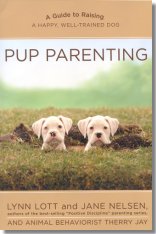
By Lynn Lott, Jane Nelsen and Therry Jay
Published by Rodale
March 2006;$14.95US/$19.95CAN; 1-59486-081-5Many dog owners feel their dogs aren’t just pets but beloved family members. For this reason, internationally renowned parenting experts Lynn Lott and Jane Nelsen, who have more than 2 million copies of their Positive Discipline books in print, have teamed up with acclaimed animal behaviorist Therry Jay to create a unique approach to “parenting” this important member of the family.
The result is Pup Parenting, the first parenting book for dogs that takes dog training to the next — and ultimate — level. This one-of-a-kind, comprehensive guide modifies effective child-rearing methods to work with the canine set. These methods represent an exciting breakthrough in dog discipline that can help make your dog a loving, responsive, and responsible family member.
Introducing their Five-Step Pup Parenting Plan, the authors offer new and fun solutions to age-old problems while presenting a more pup-friendly approach to living with and loving your dog. They’ll also advise you on how to:
- Choose a breed that fits with your family and lifestyle
- Assess your dog’s personality
- Bring straying behavior problems smartly to heel
With a kind and firm approach that rejects both the alpha discipline method and the overindulgent reward-based system, Pup Parenting is the companion you can refer to for any dog, at any age, throughout his or her life. And it’s not too late — the authors know that you can teach an old dog new tricks.
Reprinted from: Pup Parenting: A Guide to Raising a Happy, Well-Trained Dog by Lynn Lott, Jane Nelsen, and Therry Jay © 2006 Rodale Inc. Permission granted by Rodale, Inc., Emmaus, PA 18098. Available wherever books are sold, including Amazon.com


Quick Links
Get In Touch
- Email: canadasguidetodogs@gmail.com
- Email: info@canadasguidetodogs.com
- Visit us on Facebook: www.facebook.com/CanadasGuideToDogs
— CanadasGuideToDogs.com is an Amazon Associate as well as a participant in various affiliate programs, as such fees are earned from qualifying purchases.