

Yorkshire Terrier
Group: Toys
Origin: Great Britain
Weight: No more than 7 lbs (3 kg)
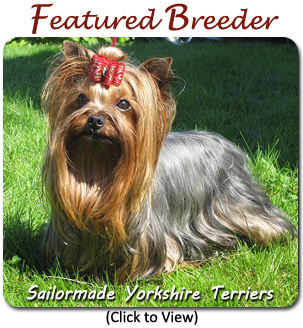
CLICK HERE to View Breeder Listings
Breed Profile
Early Yorkshire Terriers were developed in the North of England during the mid-19th century to dispatch rats in coal mines and cotton mills. They were also used by miners in rat-killing contests. It should be noted, however, that Yorkies at that time were about twice the size they are today. The Yorkie of today is one of the most glamorous and popular toy breeds. In Canada, the Yorkshire Terrier is the 6th most registered breed for 2005 and the most registered Toy breed, based on Canadian Kennel Club registrations.
It is believed that the Yorkshire Terrier was developed from several breeds, including the “Broken-Haired Scotch Terrier” and a breed known as the “Waterside Terrier”. Other crossings included the Old English Black and Tan Terrier, the Rough-Coated English Terrier, the Paisley Terrier and the Clydesdale Terrier. It is also said that the Maltese and the Skye Terrier were used as part of the development for the Yorkshire Terrier as he is known today. By the late 1870s, the average size for the Yorkshire Terrier was between three to seven pounds, which is where they are today.
Although small, the Yorkshire Terrier is spirited and alert, displaying his terrier ancestry. The Yorkie is independent yet a very devoted companion; and, despite his small size, he is always more than willing to protect his family. He is playful, inquisitive, intelligent, friendly and willing to please.
The Yorkie’s active nature makes him ideal for participating in several dog sports and activities, including: Obedience, Agility, Flyball, Frisbee, Tracking, and Earthdog Trials. He is also commonly seen working as a Therapy Dog.
In appearance, the Yorkie is a neat, compact and well proportioned little dog with plenty of self-confidence with his head held high and air of self-importance. His coat is a distinctive characteristic of the breed with a glossy, fine and silky texture. The coat on the body is long and perfectly straight. Puppies are born black and tan and are generally darker in body colour until they mature. In adult dogs, the coat is a dark steel-blue with rich tan colour on the head, legs, chest and breeches.
A Note About “Teacup Yorkies”:
A Yorkshire Terrier of the “Teacup”, “Micro Mini”, “Teenie”, or any other name meaning “extra small” variety is not ideal for several reasons. Extra tiny dogs are usually more susceptible to both hereditary and non-hereditary health problems. Other common problems include diarrhea and vomiting, and they are more likely to have problems due to anasthetics. Tiny dogs are also more easily injured. The preferable weight range for the Yorkshire Terrier is 4 to 7 lbs. This is believed to be the size which retains desired Toy qualities while maintaining optimum health. All breeders may occasionally have an unusually small Yorkie; however, a reputable breeder does not breed specifically for this trait.
A Note About Coat Colour:
The most distinctive characteristic of the Yorkshire Terrier is his beautiful, long, silky coat. According to the American Kennel Club and the Yorkshire Terrier Club of America, the coat colour should be blue and gold, blue and tan, black and gold, or black and tan. The AKC Breed Standard and the YTCA do not recognize any other colours, including gold, born blue, liver (also known as red or chocolate), and parti-colours. It is believed that the breeding of “off-coloured” Yorkies may be a genetic defect that could affect the dog’s health. On very rare occasions, a responsible breeder may have a puppy born with colour anomalies. However, the responsible breeder does not breed for this trait intentionally and these should never be promoted as being desirable or rare. For additional information, see An Important Message About Color in Yorkshire Terriers from the Yorkshire Terrier Club of America.
Health Issues
If you are considering the adoption of a Yorkshire Terrier puppy, or any breed, it is very important to be selective in choosing a responsible and reputable breeder. Ensure that the prospective puppy’s parents have all health clearances. (For more information on selecting a breeder, see the articles on the main Breed Listing and Breeders page.)
Additional Health Resources:
- Canine Health Information Center (CHIC) — Providing a source of health information for owners, breeders, and scientists that will assist in breeding healthy dogs. CHIC is a centralized canine health database jointly sponsored by the AKC/Canine Health Foundation (AKC/CHF) and the Orthopedic Foundation for Animals (OFA).
- Health and Nutrition — Growing section of the Canada’s Guide to Dogs website which includes information on several health and nutrition related issues.
- AKC Canine Health Foundation — Working towards developing scientific advances in canine health.
- Canine Eye Registration Foundation (CERF)
- Orthopedic Foundation for Animals (OFA)
- Ontario Veterinary College (OVC)
- University of Pennsylvania Hip Improvement Program (PennHip)
- HealthGene — HealthGene Corporation is the leading provider of veterinary DNA diagnostic services in Canada.
- Labgenvet — Laboratory of Veterinary Genetics is a Canadian diagnostic laboratory that offers a comprehensive service of DNA tests for veterinary genetic diseases.

Grooming Information
The Yorkshire Terrier has a single coat with no undercoat. It is glossy, fine and silky in texture, moderately long and perfectly straight on the body. Puppies are born black and tan and are normally darker in body colour. Although the coat is easy to care for, grooming must be done on a regular basis and should include frequent bathing and daily brushing. Many allergy sufferers claim that the Yorkshire Terrier is hypo-allergenic as the coat does not shed.
The Yorkie puppy’s ears should stand erect at a young age and, in order to keep them erect, the hair on the top third of the ears should be trimmed every few weeks. (If left untrimmed, the weight of the hair may cause the ears not to stand erect as they should be.)
- Grooming — This section of the Canada’s Guide to Dogs website includes tips, articles and information covering all aspects of dog grooming along with a listing of Groomers from across Canada.
Training Resources
- Training — For training information, see this growing section of the Canada’s Guide to Dogs website for tips, articles, as well as listings of training centres across Canada.
Additional Information
- Clubs, Sports & Activities — This section of the Canada’s Guide to Dogs website covers several sports and activities and also includes listings of non-breed specific Dog Clubs from across Canada.
- Working Dogs — The Working Dogs section of the Canada’s Guide to Dogs website provides information and listings of organizations that are involved in various dog jobs, such as Guide Dogs, Therapy Dogs, Police Dogs, Protection Dogs, and much more.
*NOTE 1: CHIC – The Canine Health Information Center “is a database of consolidated health screening results from multiple sources. Co-sponsored by the Orthopedic Foundation for Animals (OFA) and the American Kennel Club (AKC) Canine Health Foundation, CHIC works with parent clubs to identify health screening protocols appropriate for individual breeds. Dogs tested in accordance with the parent club established requirements, that have their results registered and made available in the public domain are issued CHIC numbers.” To learn more, visit: www.caninehealthinfo.org
*NOTE 2: The Fédération Cynologique International (FCI) is the World Canine Organization, which includes 91 members and contract partners (one member per country) that each issue their own pedigrees and train their own judges. The FCI recognizes 344 breeds, with each being the “property” of a specific country. The “owner” countries write the standards of these breeds in co-operation with the Standards and Scientific Commissions of the FCI, and the translation and updating are carried out by the FCI. The FCI is not a breed registry nor does it issue pedigrees.
Breed Listing

Quick Links
Get In Touch
- Email: canadasguidetodogs@gmail.com
- Visit us on Facebook: www.facebook.com/CanadasGuideToDogs
— CanadasGuideToDogs.com is an Amazon Associate as well as a participant in various affiliate programs, as such fees are earned from qualifying purchases.